How Non-US Teams Handle US-Only Phone Verification Requirements
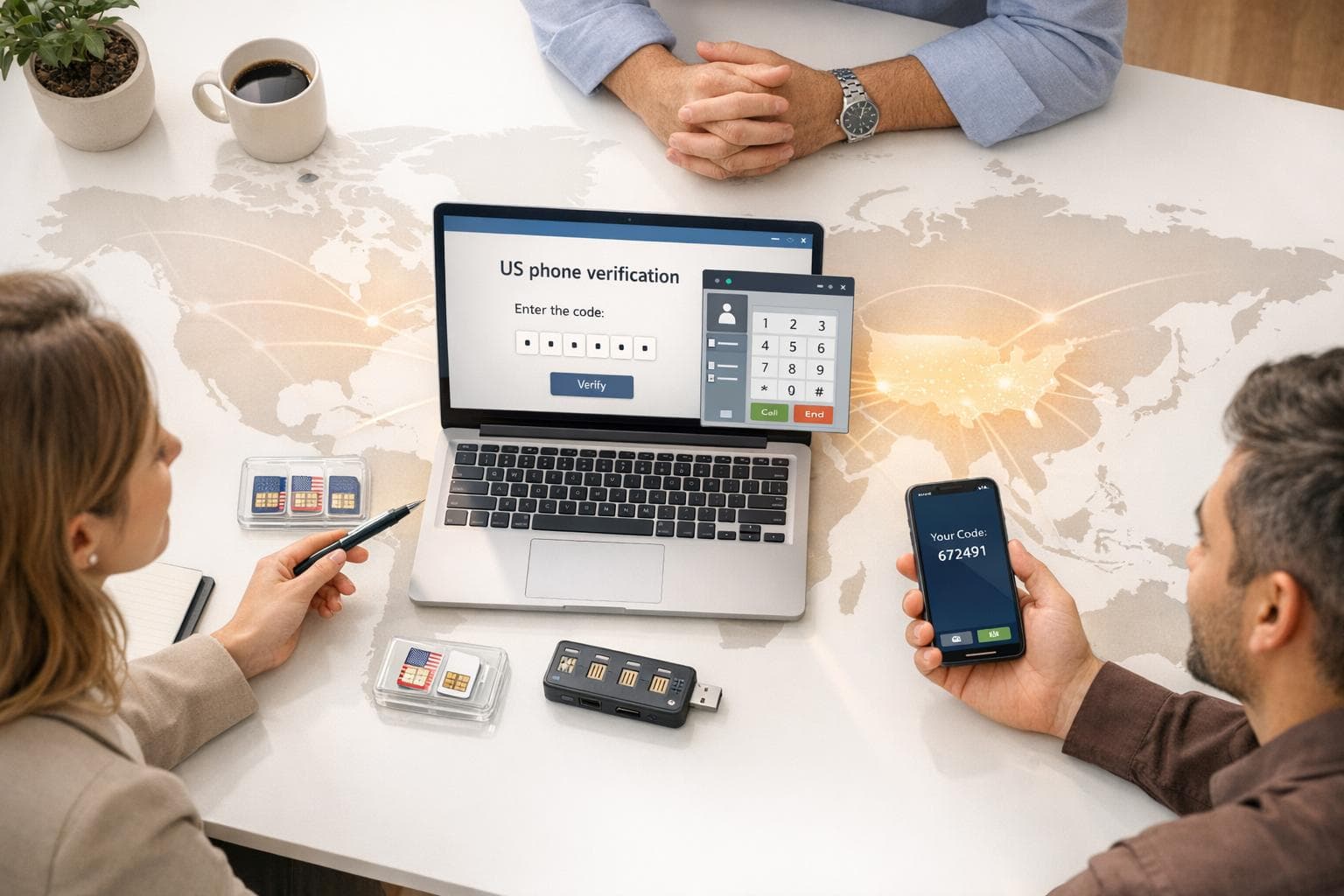
Getting past US-only phone verification is a common challenge for businesses outside the U.S. Platforms like Stripe, AWS, and PayPal often reject VoIP or temporary numbers, requiring a real U.S. mobile number. Here’s how to overcome this:
- Physical SIM Cards: Reliable but require a U.S. address for activation and a physical device to receive codes. Costs ~$3–$5/month but can be inconvenient for teams.
- Real-SIM Rentals: Services like JoltSMS provide carrier-grade U.S. numbers for $50/month. These numbers are accepted by most platforms and offer shared access via dashboards, eliminating reliance on physical devices.
- VoIP Services: Affordable (often free or up to $20/month) but frequently blocked during verification. Best for calls, not account security.
Quick Tip: Use a U.S.-based VPN when accessing accounts to avoid IP mismatches, and test numbers on low-priority platforms before using them for critical accounts.
| Solution | Cost | Setup Time | Platform Acceptance | Team Access | Best For |
|---|---|---|---|---|---|
| Physical SIM | $3–$5/month | Days/weeks | Universal | Single device | Long-term personal use |
| Real-SIM Rentals | $50/month | Instant | High | Shared dashboard | Business-critical tools |
| VoIP Services | Free–$20/month | Instant | Low | App-based | General communication |
For secure and reliable access, Real-SIM rentals are ideal for non-U.S. teams managing U.S.-based accounts. Pair them with VoIP for calls to create an efficient system.
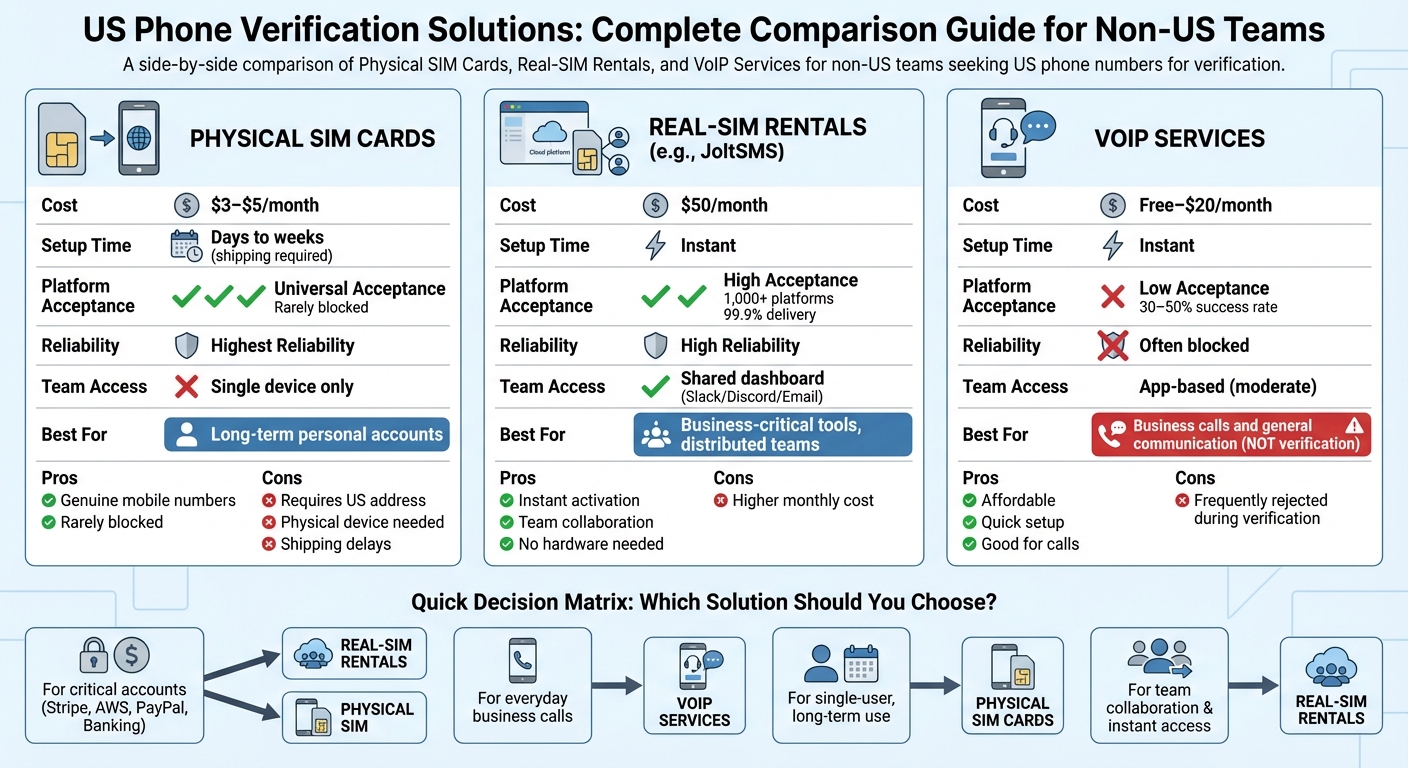
US Phone Verification Solutions Comparison: Physical SIM vs Real-SIM Rental vs VoIP
Why US Platforms Block VoIP and Virtual Numbers
US platforms block VoIP and virtual numbers to combat fraud and misuse. By performing real-time carrier lookups, they can identify whether a number belongs to a major wireless carrier like Verizon or AT&T, or if it originates from a VoIP provider. Since VoIP numbers can be created in large quantities, they’re often used for automated attacks or fake account creation. Platforms also analyze porting history and usage patterns, flagging numbers that frequently switch carriers or exhibit disposable behavior.
These technical safeguards explain why VoIP numbers often face restrictions.
The Limitations of VoIP Numbers
Services like Google Voice, OpenPhone, and Burner are great for everyday calls and texts. But when it comes to SMS verification, they often fall short. High-security platforms - such as banks, payment processors, and cloud services - block VoIP numbers because they lack a physical SIM card or a direct link to a real device, both of which are key for verifying identity. Numbers labeled as "Non-Fixed VoIP" in carrier databases are commonly rejected by these platforms.
How Platforms Detect Temporary or Virtual Numbers
Platforms go beyond basic classification by using third-party databases to sort numbers into categories like "Mobile", "Landline", or "VoIP/Non-Fixed." Typically, only mobile numbers are approved. They also monitor for red flags, such as an unusually high volume of verification requests or numbers listed on public SMS receiving websites. Such activity can result in immediate flagging or even permanent blacklisting.
This is why real SIM-based numbers, issued by major US carriers and tied to physical SIM cards, consistently pass verification checks - they function just like traditional mobile phone lines.
Method 1: Using Physical SIM Cards from US Carriers
Getting a physical SIM card from major US carriers like Verizon, AT&T, or T-Mobile is one of the simplest ways to obtain a legitimate mobile number. These real-SIM numbers are widely accepted for verification on platforms like banks, cloud services, and payment systems, where VoIP numbers are often rejected.
That said, activating these SIM cards typically requires a US address, a US-based payment method, and sometimes identity verification - steps that can pose challenges for teams based outside the US. Once activated, the SIM works like any standard mobile line, but it does require a physical device to receive SMS codes. Since the number is directly tied to the SIM card, managing accounts for services such as Stripe, AWS, or Google might mean one team member has to hold the device and share verification codes with others. This setup can quickly become inefficient.
How to Purchase and Activate a US SIM Card from Abroad
If you're overseas, here's how you can get a US SIM card:
- Many US carriers allow you to order prepaid SIM cards online and ship them internationally. During checkout, you'll need to provide a US billing address. To work around this, some teams use mail forwarding services or a contact address within the US.
- Activation is done via the carrier's website or app. You'll need to input the SIM card number, choose a plan, and provide payment details. While some carriers accept international credit cards, others may require a US-issued card.
- Once the SIM card is activated, insert it into an unlocked phone, and you're ready to receive SMS codes.
Challenges with Long-Term Usage
While physical SIM cards are reliable for verification, they come with some long-term hurdles.
One key issue is maintaining the SIM's active status. Prepaid plans require regular top-ups, and missing a payment cycle can lead to the number being deactivated. For business-critical tools that might need re-verification weeks or months later, losing access to the number could result in permanent account lockout [2][3].
Additionally, if the SIM card or the device it's in gets lost or damaged, you risk losing access to any accounts tied to that number. Replacing the SIM often means getting a new number, which can be problematic if services like WhatsApp or your bank already have the old number on file. To avoid these issues, it's a good idea to maintain the same real-SIM number for at least 1–2 years to handle any re-verification needs down the line [2].
Method 2: Using Real-SIM Rental Services
Real-SIM rental services provide a simple and effective alternative to physical SIM cards. Platforms like JoltSMS offer US mobile numbers backed by carrier-grade SIMs instead of VoIP. These numbers are rented on a monthly basis (with a 30-day minimum), and as long as your subscription remains active, the number remains exclusively yours.
How Real-SIM Rental Services Work
With Real-SIM services, getting started is quick and hassle-free. After making a $50/month payment, your number is assigned within seconds. This number is linked to a physical SIM hosted by the provider, making it appear as a standard mobile line from major US carriers. Verification codes sent to this number are accessible via a centralized web dashboard. These codes can also be routed to tools like Slack, Discord, email, or custom webhooks, allowing your team to access them in real time without needing a physical device. This setup avoids the re-verification issues often encountered with physical SIM cards.
You can add up to 10 team members, each with specific roles such as Owner, Manager, or Viewer, to manage billing and settings. The numbers are private and exclusively yours for the duration of your rental - they are never shared or recycled. For teams handling multiple client accounts or departments, the dashboard includes labeling options, so you can easily tag numbers (e.g., "Dev Stripe Account" or "Client XYZ AWS") for better organization.
Let’s take a closer look at why this service is a step ahead of other options.
Advantages Over VoIP and Temporary Numbers
Real-SIM rentals come with several advantages that make them more reliable than VoIP or temporary numbers.
The biggest advantage is platform acceptance. JoltSMS boasts a 99.9% delivery rate and compatibility with over 1,000 platforms, including banks, Stripe, AWS, and WhatsApp. If you've ever faced the dreaded "This number cannot be used for verification" error with VoIP apps like Google Voice, OpenPhone, or Burner, switching to a Real-SIM number can resolve the problem.
Another key benefit is consistency. Unlike temporary numbers that expire after use, Real-SIM rentals provide a stable number for sign-ups and re-verifications, ensuring smooth access to critical accounts. While the month-to-month subscription offers flexibility to cancel anytime without penalties, it’s recommended to keep the same number for 6–12 months for business-critical tools to avoid disruptions.
| Feature | VoIP Apps (e.g., Google Voice, Burner) | Real-SIM Rentals (JoltSMS) |
|---|---|---|
| Technology | Virtual/Cloud-based | Physical SIM/Carrier-grade |
| Acceptance | Often rejected by banks and major platforms | Widely accepted as a real mobile number |
| Team Access | Limited to one login | Shared via Slack/Discord/Dashboard |
| Longevity | Varies; numbers may be recycled | Month-to-month (retain as long as needed) |
| Primary Use | Calling and general texting | Reliable account verification and 2FA |
Method 3: Combining VoIP Services with Real-SIM Solutions
To address the limitations of using VoIP or real-SIM services alone, combining these technologies creates a more effective solution for teams operating outside the U.S. By leveraging the strengths of both, you can assign each to the tasks they handle best. This approach ensures efficiency and reliability by matching the right tool to the right job.
When to Use VoIP Numbers
VoIP services like Google Voice, OpenPhone, or RingCentral are ideal for day-to-day business communication. They shine in areas like outbound sales calls, customer support, and internal team collaboration. Plus, they offer features like call recording, IVR systems, and CRM integrations - all at affordable monthly rates.
For teams calling U.S. customers from overseas, VoIP numbers with local area codes can significantly improve answer rates. In fact, calls from local numbers are four times more likely to be answered than those from international numbers [4]. While VoIP is perfect for operational tasks, it's not suited for account security. Many high-security platforms - such as Stripe, AWS, and major banks - reject VoIP numbers during account setup or verification [1].
While VoIP is great for communication, real-SIM technology is the go-to for security and verification.
Why Real-SIM Technology Works Better for Verification
Real-SIM numbers are highly reliable for platform verification. Services like JoltSMS use physical SIM cards from major U.S. carriers, which is why they pass verification on over 1,000 platforms with a 99.9% delivery success rate [1].
To get the best of both worlds, segment your usage: use VoIP for calls and customer-facing tasks, while reserving a dedicated real-SIM number for critical accounts like payment processors, cloud infrastructure, or banking apps. This strategy combines the cost-efficiency of VoIP for everyday operations with the dependability of real-SIM for essential accounts.
sbb-itb-070b8f8
Comparison of Solutions: Physical SIMs, Real-SIM Rentals, and VoIP
Let’s break down the key differences between physical SIMs, real-SIM rentals, and VoIP services to help you decide which works best for your needs. Each option has its strengths and weaknesses when it comes to accessing US-based platforms, especially for verification purposes.
Physical SIM cards from providers like AT&T or T-Mobile are a reliable choice since they’re genuine mobile numbers, which rarely face blocks. They’re cost-effective, usually priced around $3–$5 per month, but they come with some drawbacks. For instance, setting them up requires shipping, which can take days or even weeks. Plus, only the person with the physical device can access the verification codes, making them less ideal for teams spread across different locations.
Real-SIM rental services offer the same reliability as physical SIMs without the need for hardware. They’re activated instantly through an online dashboard, and verification codes can be routed directly to team platforms like Slack or Discord. While they’re more expensive at around $50 per month, they eliminate shipping delays and allow multiple team members to access the codes, making them a practical option for distributed teams outside the US.
VoIP services like Google Voice or OpenPhone are budget-friendly, often free or costing up to $20 per month, and can be set up in just minutes. However, they have a major limitation: VoIP numbers are frequently flagged and blocked during verification because platforms can identify them through carrier lookups. This means they only work for verification about 30–50% of the time, making them more suitable for business calls than critical account setups.
Comparison Table
Here’s a quick overview of how these solutions stack up:
| Factor | Physical SIM Cards | Real-SIM Rentals | VoIP Services |
|---|---|---|---|
| Cost | ~$3–$5/month + SIM purchase | ~$50/month | Free to ~$20/month |
| Setup Time | Days to weeks (shipping) | Instant | Instant |
| Platform Acceptance | Universal (genuine mobile numbers) | High (accepted on over 1,000 platforms) | Low (30–50% success rate) |
| Reliability | Highest | High (99.9% delivery) | Often blocked |
| Team Access | Limited (single device) | Easy (shared dashboard via Slack/Discord) | Moderate (app-based) |
| Best For | Long-term personal accounts | Non-US teams needing instant, shared access | Business calls - not verification |
If you’re dealing with critical accounts like Stripe, AWS, or banking platforms, avoid using VoIP numbers altogether. Physical SIMs are a solid choice for managing single, long-term accounts, while real-SIM rentals are ideal for teams needing shared, reliable access without the hassle of physical hardware.
Best Practices for US Phone Verification
Getting past US phone verification is just the beginning; staying in the game requires some careful planning. If you're a non-US team, you might face re-verification weeks or even months later. Without preparation, you could lose access to essential services like Stripe, AWS, or banking platforms. So, what can you do to stay ahead? Let’s dive into the key practices, starting with keeping your network consistent.
Maintaining Consistent IP Geolocation
Using a US phone number with a non-US IP address can raise red flags. Platforms often see this mismatch as suspicious, potentially triggering anti-fraud systems. This could mean verification failures or even account suspensions. To avoid these headaches, always use a US-based VPN or proxy when setting up or accessing accounts tied to US phone verification. Stick to the same US IP address for both sign-up and future logins to keep things smooth. If the service allows you to choose an area code - like NYC or SF - it’s a smart move to align your VPN location with that region for added consistency.
Securely Storing Verification Credentials
Losing access to verification codes could lock you out of your accounts. To prevent this, route all SMS codes to a centralized, company-controlled dashboard. Avoid relying on personal phone numbers, especially since they can become inaccessible if an employee leaves the company. Instead, set up role-based access controls, so team members only access the credentials they need. For added security, forward codes to private, restricted channels, such as dedicated Slack or Discord groups. For critical accounts like AWS or Google, it’s wise to set up emergency procedures, such as backup administrators and hardware security keys, to avoid being locked out entirely.
Once your credentials are secure, it’s time to put your setup to the test.
Testing Numbers Before Critical Verifications
Before using a new US phone number for high-stakes accounts like Stripe or business banking, test it on a less critical platform first. Sign up for a free service or app that uses SMS verification to make sure the number works as expected. This step helps you confirm reliable SMS delivery and identify potential issues, like carrier blocks or delays, before the phone number is needed for something more important. A quick test run can save you a lot of trouble down the line.
Conclusion: Choosing the Right Solution for Your Team
If your team operates outside the US but needs US phone verification, you’ve got three main options: physical SIM cards, VoIP services, or real-SIM rentals. Each comes with its own pros and cons. Physical SIM cards, for instance, have high success rates but require someone to physically manage the device - a logistical headache for many teams. That’s where comparing other solutions, like VoIP services, becomes essential.
VoIP services (think Google Voice or Burner) are fine for everyday calls but tend to fail during verification processes, as they’re often flagged or blocked. On the other hand, real-SIM rentals, such as JoltSMS, offer a much more reliable option with a 99.9% success rate. Why? They utilize carrier-grade SIM hardware, passing the same carrier lookups and prefix checks as physical SIM cards. For $50 per month, you can secure a dedicated US number that forwards verification codes directly to your team’s Slack or Discord channels - solving the constant “who has the phone?” problem.
For critical accounts like banking, Stripe, AWS, or PayPal, real-SIM technology is the way to go from the start. These platforms often require re-verification weeks or even months after sign-up. A VoIP number might get flagged, and a physical SIM card could easily be misplaced, putting your access at risk. To avoid disruptions, plan to keep your real-SIM number active for at least 6–12 months for lower-priority accounts and 1–2 years for essential business tools. By using VoIP for general calls and reserving real-SIM rentals for verification, you’re setting up a strong, secure system for your team.
"Your personal number shouldn't be tied to every work account. JoltSMS exists so teams can keep verification separate from individual phones." - JoltSMS
Ultimately, the right choice depends on your team’s specific needs. For most non-US businesses working with US-based platforms, real-SIM rentals strike the perfect balance between reliability, ease of use, and long-term security. Pairing VoIP for communication with real-SIM rentals for verification ensures a dependable and efficient strategy for managing US-centric accounts.
FAQs
Why don’t VoIP numbers work for US phone verification?
VoIP numbers often face rejection during US phone verification processes because they are perceived as less secure and more susceptible to misuse. Many platforms link these numbers to activities like fraud, spam, or creating multiple accounts, leading them to block VoIP numbers to uphold security and trust.
Compared to real-SIM numbers, VoIP numbers lack the dependability required to confirm identity. This makes them a common failure point for verification on US-focused platforms such as banks, app stores, and SaaS services. If you need guaranteed acceptance, opting for a real-SIM number is the more reliable choice.
What are the benefits of using Real-SIM rentals instead of physical SIM cards?
Using Real-SIM rentals brings a host of advantages compared to traditional physical SIM cards, particularly when it comes to ease of use, adaptability, and dependability. Services like JoltSMS let you rent a US mobile number without the hassle of handling or swapping physical SIM cards. This ensures you can maintain consistent verification numbers, even for platforms that typically reject VoIP or virtual numbers.
Real-SIM rentals operate on carrier-grade hardware, which means they’re highly compatible with over 1,000 platforms, including banks, SaaS tools, and app stores. On top of that, many of these services feature flat-rate pricing and user-friendly dashboards or APIs, streamlining the process of scaling your verification needs without the logistical challenges.
Essentially, Real-SIM rentals offer the best of both worlds: the credibility of physical SIM cards paired with the convenience of digital management, making them a dependable choice for long-term SMS verification.
How can non-US teams ensure consistent IP geolocation for US phone verification?
Non-US teams often encounter hurdles with IP geolocation when attempting US phone verification. This is largely due to platform restrictions and compliance rules. A reliable solution is to use real-SIM, non-VoIP US phone numbers that are tied to physical SIM cards. These numbers are widely accepted as genuine by verification systems, sidestepping the common issues linked with virtual or VoIP numbers.
To enhance success rates, opt for numbers associated with specific US regions or area codes, as this helps maintain location consistency. Additionally, sticking to the same number for re-verifications reduces the risk of being flagged for discrepancies. Leveraging real-SIM numbers supported by carrier-grade infrastructure can significantly boost verification reliability while ensuring a steady geolocation profile.