Why OAuth Fails with VoIP Numbers
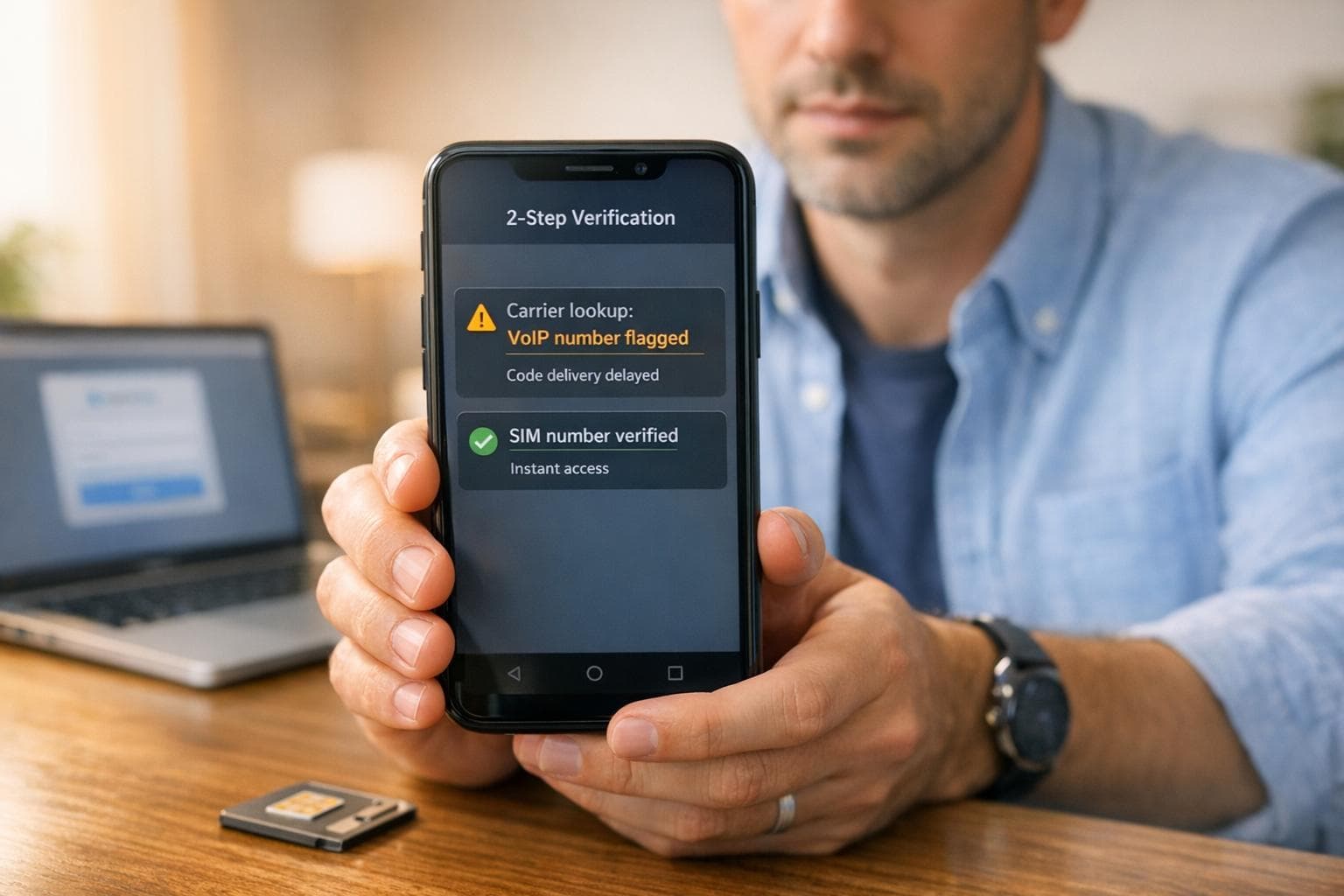
When trying to verify accounts on platforms like Google, Stripe, or AWS, using a VoIP number often leads to errors or silent failures. Here's why:
- VoIP Numbers Are Flagged: Platforms use carrier lookup tools to identify the number type. VoIP numbers, classified as "VOIP" or "Fixed VoIP", are often blocked due to their association with spam and recycled ranges.
- Low Success Rates: VoIP numbers have a 20–40% success rate for verification, compared to 95–99% for real SIM-based mobile numbers.
- Delayed or Failed OTP Delivery: VoIP routing causes delays (2–4 seconds) or silent failures, frustrating users and leading to abandoned verification attempts.
- Re-verification Issues: Accounts created with VoIP numbers are more likely to face re-verification or suspension, especially on high-security platforms like financial services.
For reliable account access, businesses should use real SIM-based numbers. Services like JoltSMS provide dedicated, carrier-grade numbers with a 99.9% success rate for verification across 1,000+ platforms, ensuring uninterrupted access.
| Factor | VoIP Numbers | Real SIM Numbers |
|---|---|---|
| Success Rate | 20–40% | 95–99% |
| Delivery Speed | Variable (2–4 seconds) | Consistent (<5 seconds) |
| Risk of Rejection | High | Low |
| Best Use | Calls, messaging | Verification, 2FA |
Takeaway: Avoid VoIP numbers for verification. Use real SIM-based numbers to prevent errors, delays, and account lockouts.
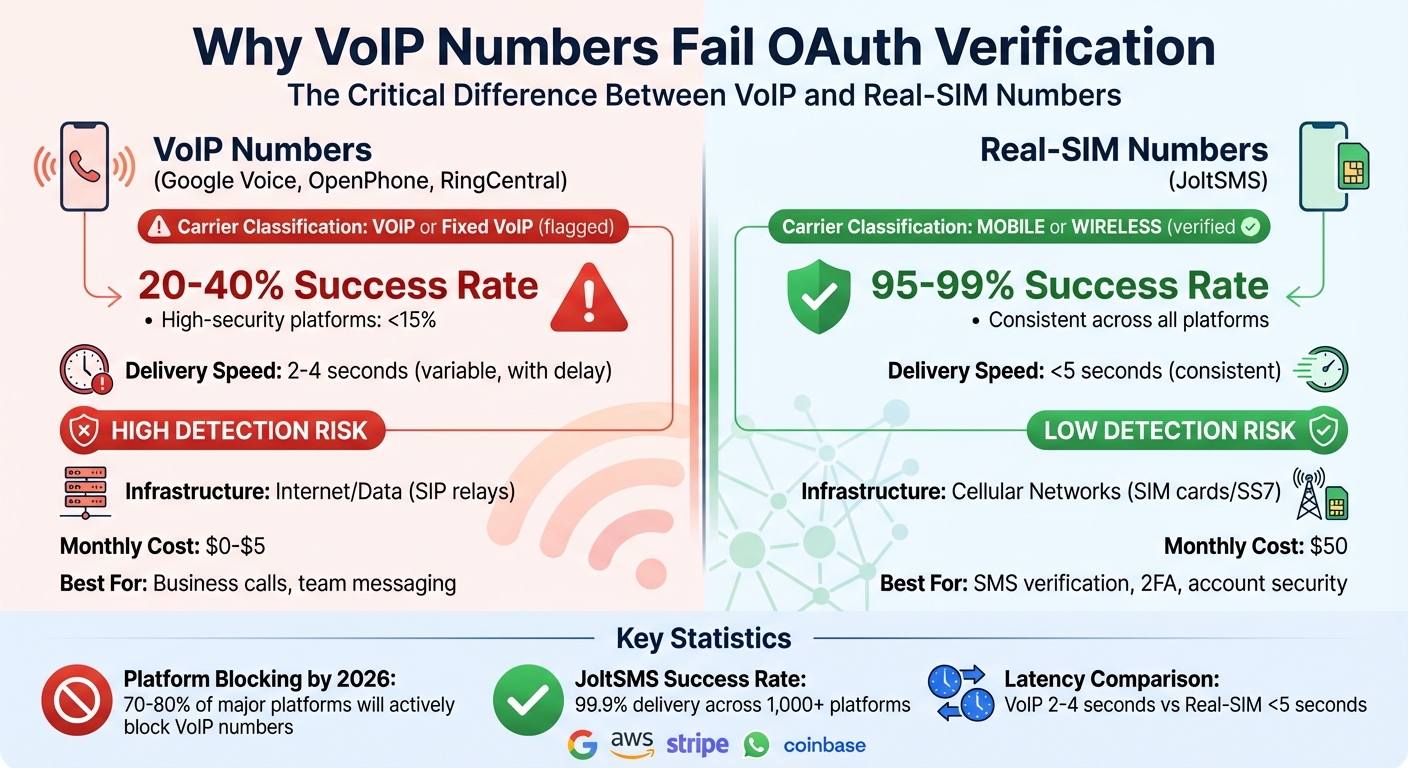
VoIP vs Real-SIM Numbers: OAuth Verification Success Rates Comparison
Why OAuth Platforms Reject VoIP Numbers
How Platforms Detect and Block VoIP Numbers
OAuth platforms rely on APIs to check phone numbers before sending verification codes. These APIs analyze a key field - "line_type" - which categorizes numbers as MOBILE, VOIP, LANDLINE, PREPAID, or UNKNOWN [3]. Numbers flagged as VoIP are typically rejected or given lower priority. Beyond this classification, platforms also examine the carrier. Numbers associated with VoIP aggregators like Bandwidth.com are often blocked immediately, while those tied to major carriers like AT&T, Verizon, or T-Mobile are generally approved [3]. Risk scoring systems further assess factors like the age of the number, with newer VoIP numbers being deemed riskier than established mobile numbers [3].
One way platforms verify mobile numbers is by measuring latency. Genuine mobile numbers have a predictable latency of 400–600 ms (via SS7 or IMS), whereas VoIP numbers show variable delays of 2–4 seconds due to SIP relays. These carrier lookup checks add only 100–200 ms to the overall verification process [3]. This combination of detection methods often leads to the error messages users face.
"A number classified as VOIP on Bandwidth.com or a generic VoIP aggregator gets blocked. The process fails without clear user feedback."
– Josh Mellow, Privacy and connectivity enthusiast [3]
Common Error Messages with VoIP Numbers
Users frequently encounter errors like "This number cannot be used for verification" or experience delays in receiving verification codes. Silent failures are particularly frustrating - platforms may claim a code was sent, but carrier checks have already blocked the message. Even if a VoIP number eventually receives the code, the account might be flagged for manual review or require re-verification later due to its high-risk status [3]. Additionally, delays of 45–90 seconds, caused by routing through low-cost aggregators, often lead users to abandon the process altogether.
Why Companies Keep Using VoIP Despite Verification Problems
VoIP numbers remain popular for their affordability and flexibility in handling calls and internal messaging. Services like Google Voice, OpenPhone, and RingCentral offer these features for as little as $0 to $5 per month, requiring no physical hardware and integrating easily with tools like Slack or Teams [2][1]. However, their limitations with SMS verification highlight the need for a dedicated real-SIM number when accessing platforms that reject virtual numbers. The best approach is to separate your communication tools: use VoIP for calls and team messaging, but rely on a real-SIM number for verification purposes. Recognizing these limitations helps ensure smoother access to services.
sbb-itb-070b8f8
VoIP Services That OAuth Blocks
Google Voice Verification Failures
Let's take a closer look at how Google Voice, a widely-used VoIP service, struggles with verification on platforms like WhatsApp, Instagram, and banking apps. When you try to verify an account using a Google Voice number, the carrier lookup API flags the line_type as "VOIP", which often leads to either outright rejection or a silent failure where the verification code never arrives [3].
Financial institutions are particularly strict about blocking Google Voice numbers. Banks, cryptocurrency exchanges like Coinbase, and payment services such as Stripe have policies against virtual numbers, as these can be easily acquired with little identity verification [2][3]. Even Google's own systems may flag repeated use of VoIP numbers for account creation, creating additional challenges for businesses managing multiple accounts [4].
Other VoIP Services Blocked by OAuth
The issue isn't limited to Google Voice. Platforms also frequently reject numbers from services like OpenPhone, RingCentral, and TextNow [1][2]. While these services are great for business communications and team collaboration, their numbers are labeled as "VOIP" or "Fixed VoIP" in carrier databases, making them easy for automated systems to filter out.
By 2026, an estimated 70–80% of major platforms actively block VoIP numbers using carrier lookup databases [2]. On platforms with stringent fraud prevention measures, the success rate for VoIP number verification can drop below 15%, compared to a 95–99% success rate for real-SIM numbers [3]. Additionally, some platforms conduct post-verification checks, which can result in flagged or suspended accounts months after they were created with a VoIP number [2][3].
VoIP vs. Real-SIM Numbers: Comparison Table
The table below highlights the key differences between VoIP and real-SIM numbers:
| Factor | VoIP Numbers (Google Voice, OpenPhone, RingCentral) | Real-SIM Numbers (JoltSMS) |
|---|---|---|
| Carrier Classification | "VOIP" or "Fixed VoIP" | "MOBILE" or "WIRELESS" |
| Success Rate on OAuth Platforms | 20–40% (often below 15% on high-security apps) | 95–99% |
| Delivery Speed | Variable (2–4 seconds or delayed) | Consistent (under 5 seconds) |
| Detection Risk | High (easily identified via carrier databases) | Low (indistinguishable from personal phones) |
| Infrastructure | Internet/Data (SIP relays) | Cellular Networks (SIM cards/SS7) |
| Best For | Business calls and team messaging | SMS verification, 2FA, and account security |
| Typical Cost | $0–$5/month | $50/month (JoltSMS dedicated number) |
This stark contrast explains why real-SIM numbers, like those offered by JoltSMS, are crucial for seamless SMS verification and maintaining account security.
How JoltSMS Fixes OAuth Verification with Real-SIM Numbers
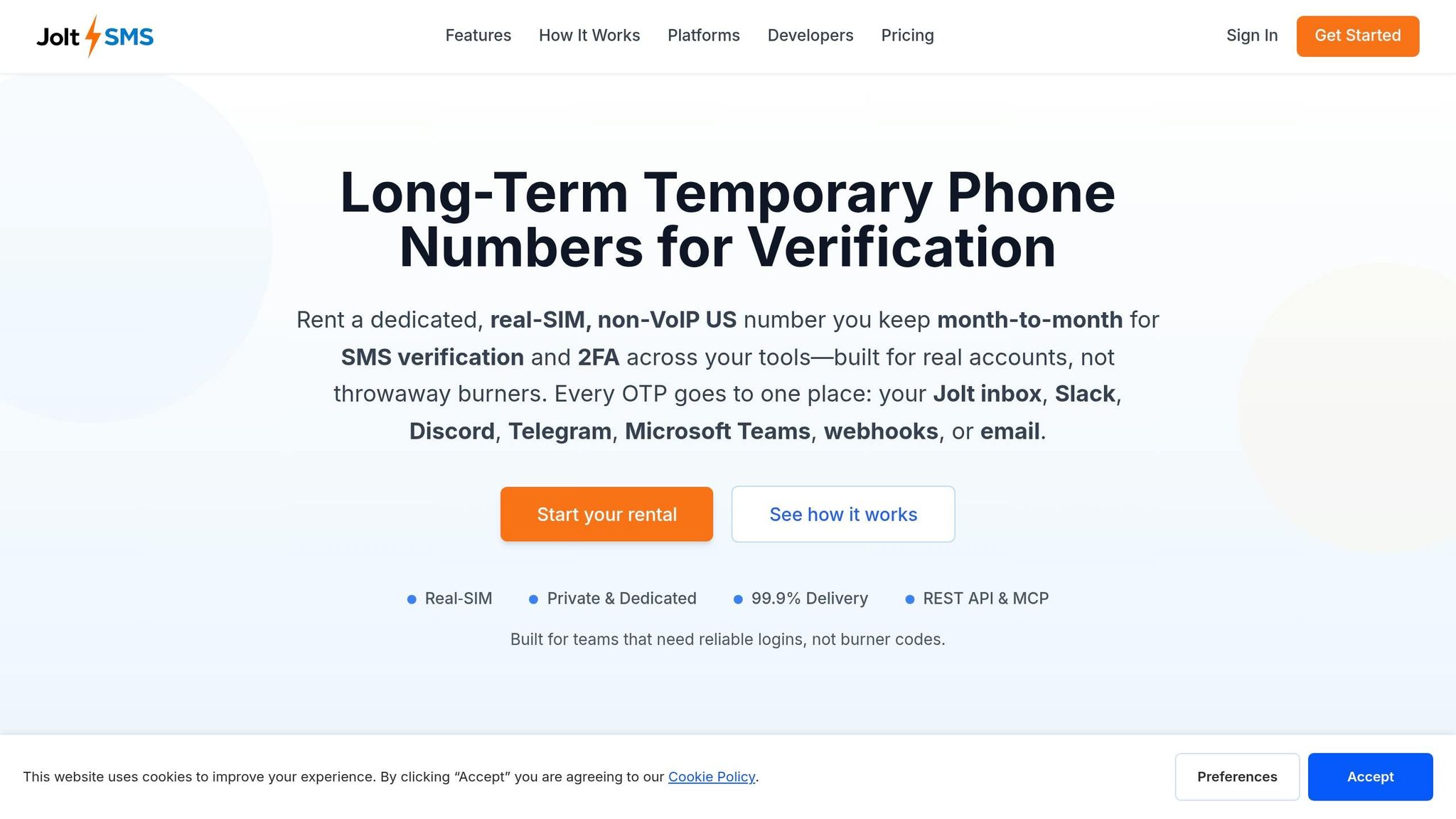
Real-SIM Technology for 99.9% Delivery Rates
JoltSMS leverages carrier-grade SIM hardware, ensuring its numbers are recognized as "MOBILE" with a standard risk score. This stands in stark contrast to VoIP numbers, which are often flagged as "VOIP" and can trigger verification issues. The use of real-SIM technology directly tackles the risks associated with VoIP numbers, offering a 99.9% success rate in SMS delivery across over 1,000 platforms. These include major services like Google, WhatsApp, Coinbase, Stripe, and AWS [3]. With dedicated numbers, JoltSMS eliminates the risk of inheriting a bad reputation, avoiding the silent delivery failures that frequently occur with VoIP numbers.
JoltSMS Features for OAuth Workflows
Designed specifically for business verification, JoltSMS provides a dedicated US number for $50 per month. This package includes unlimited inbound SMS, instant code delivery through webhooks to platforms like Slack or Discord, a real-time dashboard, and REST API integration for automation. Using a secure HMAC-SHA256–signed webhook system, codes are delivered to your applications almost instantly - cutting down delays that can exceed 90 seconds with VoIP numbers.
Each number supports up to 10 team members with role-based access (Owner, Manager, Viewer), solving the common "what's the code?" issue tied to personal phone verifications. The service also comes with round-the-clock support and a money-back guarantee if SMS verification fails. This comprehensive setup simplifies OAuth workflows and ensures smooth, uninterrupted operations for businesses.
Why Businesses Choose JoltSMS Over VoIP
For businesses, reliable verification is non-negotiable. While VoIP services like Google Voice or OpenPhone are great for calls, they often fall short for SMS verification. Many platforms block VoIP numbers to combat fraud, leading to verification failures. JoltSMS, on the other hand, maintains a consistent classification and reputation, passing both initial and follow-up verification checks - essential for platforms that re-verify months after account creation.
Conclusion
Main Points
OAuth platforms reject VoIP numbers because carrier databases flag them as "VOIP" or "Fixed VoIP", not due to issues with verification APIs. As Josh Mellow, a privacy and connectivity expert, explains:
"The problem is not the verification API. The problem is the phone numbers." [3]
By 2026, an estimated 70–80% of platforms will actively block VoIP numbers. This will lead to pass rates of only 20–40% on standard platforms and less than 15% on high-security services like WhatsApp and financial apps [2][3].
On the other hand, real-SIM numbers, categorized as "MOBILE" or "WIRELESS", boast success rates of 95–99% across all platform types [2][3]. They deliver verification codes in under 5 seconds, avoiding the delays or silent failures often associated with VoIP routing [2][3]. Additionally, real-SIM numbers ensure seamless re-verification - a critical feature when platforms perform security checks weeks or months after sign-up. Disposable numbers, by contrast, often lead to account lockouts during these checks [1][5]. This makes real-SIM numbers not just a better option, but a necessary one for maintaining secure access.
JoltSMS – Dedicated Real-SIM US Phone Numbers for Business SMS Verification offers dedicated US real-SIM numbers for $50/month. With unlimited inbound SMS, instant webhook delivery to platforms like Slack or Discord, and a 99.9% delivery rate across over 1,000 platforms - including Google, AWS, Stripe, and WhatsApp - JoltSMS provides a reliable solution [1]. Unlike VoIP services, which may be fine for calls but fall short for verification, JoltSMS uses carrier-grade hardware specifically designed to meet OAuth requirements every time.
These findings highlight the need to take immediate action to secure your business's digital access.
Next Steps for Your Business
- Review your current verification setup and replace VoIP numbers with real-SIM options to avoid account lockouts. Focus on critical platforms like Stripe, AWS, Google Workspace, and social media accounts [4][2][3].
- Integrate your JoltSMS number with tools like Slack, Discord, or Microsoft Teams for instant, team-wide delivery of verification codes. Use role-based access controls (Owner, Manager, Viewer) to maintain security [1].
- Ensure your subscription remains active to avoid losing access to your number. If a platform requests re-verification months after sign-up, having an inactive number could result in permanent account loss. At $50/month with a money-back guarantee if verification fails, this is a simple yet essential safeguard against lockouts [1].
FAQs
How can I check if my number is VoIP?
To determine if a phone number is VoIP, you can use a carrier lookup tool. These tools identify whether the number is internet-based or connected to a physical SIM card. For example, numbers from services such as Google Voice, TextNow, or Burner are usually VoIP. On the other hand, numbers from traditional carriers like Verizon or AT&T are typically non-VoIP. A carrier lookup tool remains the most dependable method to verify whether a number is VoIP.
Why does a site say it sent a code but I never get it?
VoIP numbers often face restrictions or outright rejection on many platforms when it comes to SMS verification. This happens because VoIP numbers are internet-based, making them less reliable and harder to trace compared to real-SIM numbers. As a result, SMS delivery can fail. Opting for a real-SIM number provides a dependable way to receive verification codes without issues.
What should my business use VoIP numbers for vs verification?
VoIP numbers are a great choice for handling business calls and internal communications. They’re flexible and cost-effective, making them a popular option for companies.
However, when it comes to SMS verification or account re-verification, real-SIM, non-VoIP numbers - like those provided by JoltSMS - are the better option. Platforms such as Google, Stripe, and PayPal often block VoIP numbers due to security concerns. Real-SIM numbers, on the other hand, are widely accepted and provide a reliable solution for successful verification.