Temporary Phone Numbers and Fraud: How Platforms Detect Abuse
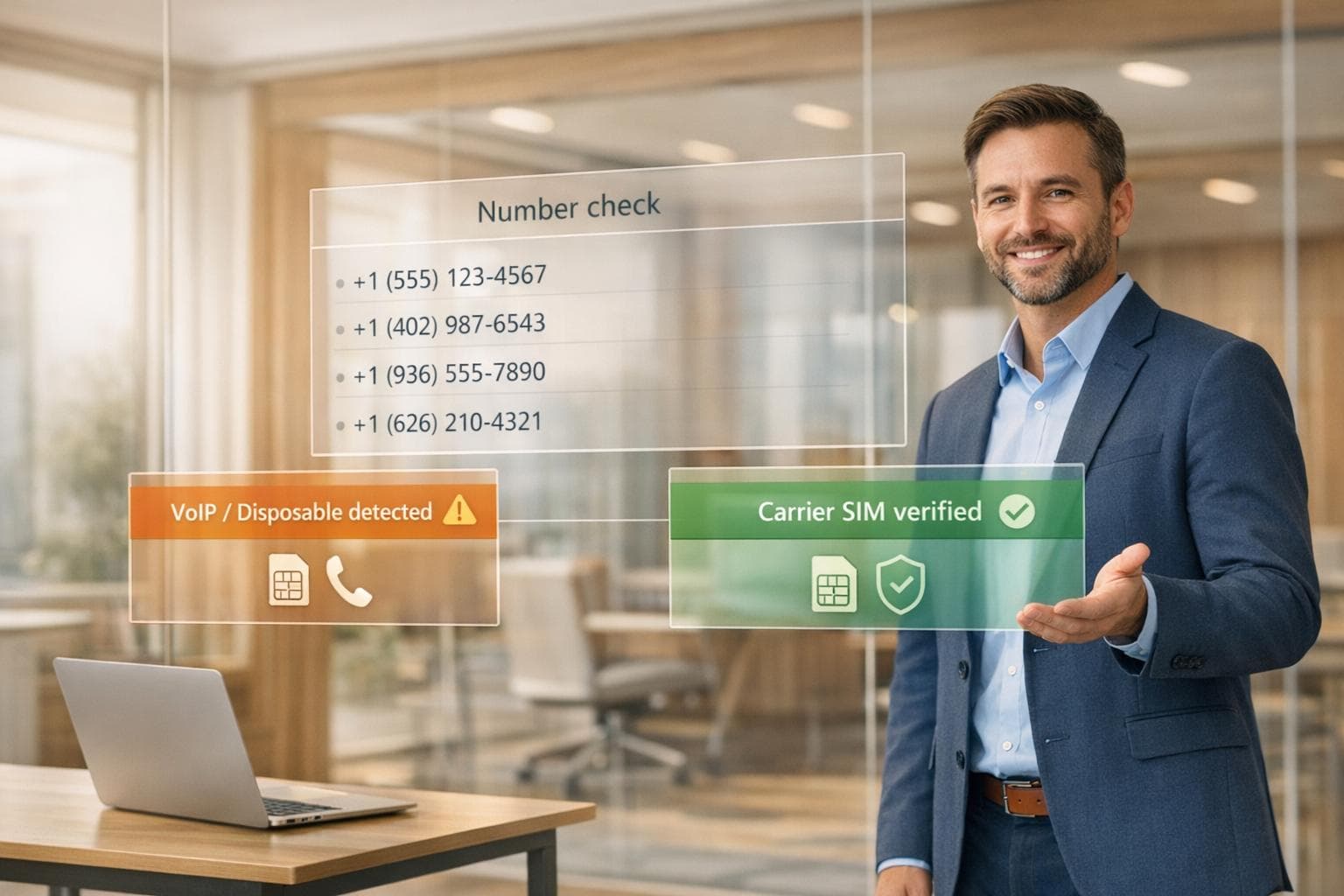
Temporary phone numbers offer privacy but are often exploited for fraud. Fraudsters use these numbers to bypass verification systems, create fake accounts, and commit scams. Platforms now block many VoIP and disposable numbers due to their association with abuse, but this sometimes impacts legitimate users. Businesses relying on such numbers face challenges like verification failures, account lockouts, and financial losses.
Key takeaways:
- Temporary Numbers: Include VoIP (virtual) and Real-SIM (carrier-issued) numbers. VoIP is cheap and easily abused; Real-SIM is harder to misuse.
- Fraud Risks: 74% of fintech fraud involves mobile numbers. Common scams include fake accounts, SMS pumping, and SIM swaps.
- Detection Tools: Platforms use AI, databases, and risk scoring to flag suspicious numbers. VoIP and disposable numbers are often blocked.
- Business Impact: Verification failures with VoIP numbers can disrupt operations and cost businesses thousands.
Solution: Use Real-SIM numbers tied to physical SIM cards for reliable verification. Services like JoltSMS provide dedicated Real-SIM numbers for $50/month, ensuring secure and uninterrupted access to platforms like WhatsApp, Stripe, and banking apps.
How Platforms Detect Abuse from Temporary Phone Numbers
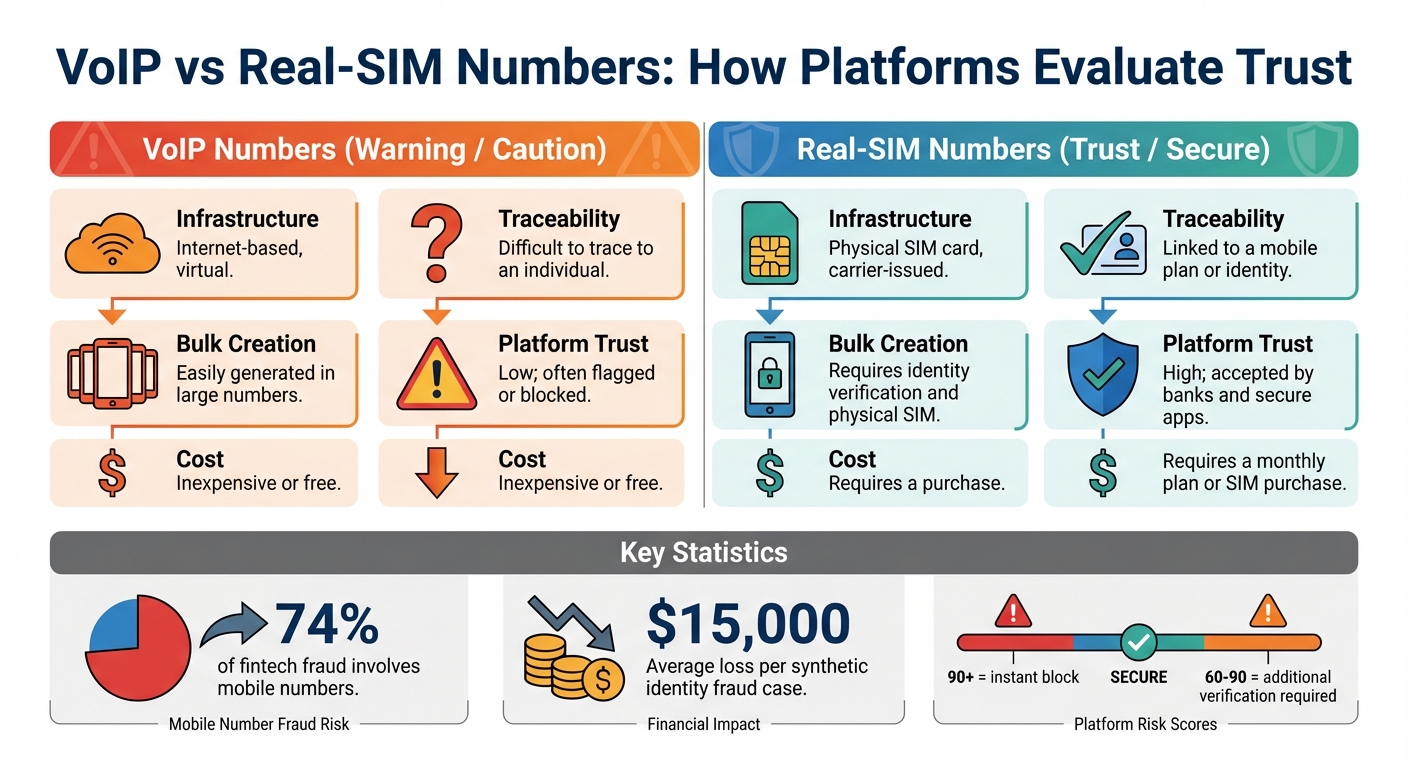
VoIP vs Real-SIM Numbers: Platform Trust and Fraud Detection Comparison
Platforms use sophisticated risk engines to verify phone numbers by analyzing their validity, type, and reputation [3]. These systems evaluate whether a number is active, classify it as VoIP or Real-SIM, and check for any history of misuse. The ultimate aim? To stop bad actors before they can exploit resources or create fake accounts through tactics like SMS pumping attacks. To achieve this, platforms rely on a range of detection methods.
Detection Methods Platforms Use
Fraud detection systems often use database cross-referencing and number type analysis. Platforms maintain up-to-date databases of disposable number ranges and virtual service providers [2]. When a number is submitted, these systems can quickly identify if it belongs to providers such as Google Voice or Skype. They also distinguish between mobile, landline, VoIP, and disposable numbers. Fraudsters tend to favor VoIP and disposable numbers because they lack a direct physical connection [2].
AI has taken detection to the next level. Machine learning models can analyze billions of telecom and behavioral signals to spot anomalies that traditional rules might miss [3]. These systems go beyond just examining the phone number - they also compare the phone number's country of origin with the user's IP address or claimed location. For example, a U.S. phone number paired with a Nigerian IP address is a glaring red flag [3].
Red Flags That Trigger Fraud Alerts
Certain patterns immediately raise fraud alerts. For instance, sequential phone numbers (like those ending in 1001, 1002, 1003) often indicate bot-driven activity. Similarly, a high volume of OTP (one-time password) requests to the same number or prefix in a short period is a telltale sign of SMS pumping fraud. In these cases, criminals profit by routing messages to premium-rate numbers they control.
Another warning sign is bulk account creation. If thousands of accounts are registered using numbers from the same range or provider, platforms know something suspicious is happening. Risk engines assign scores from 0 to 100 to assess the likelihood of fraud. Numbers scoring above 90 are typically blocked instantly, while scores between 60 and 90 may prompt additional verification, like CAPTCHAs [3]. A lack of a verified identity connection is particularly alarming. Temporary VoIP numbers, which aren't tied to a physical identity or long-term contract, are often used for anonymous abuse. This is why Real-SIM numbers are more likely to pass verification checks.
VoIP vs. Real-SIM Numbers: How Platforms Tell the Difference
Platforms evaluate a number’s trust level by examining its infrastructure:
| Feature | VoIP Numbers | Real-SIM Numbers |
|---|---|---|
| Infrastructure | Internet-based, virtual | Physical SIM card, carrier-issued |
| Traceability | Difficult to trace to an individual | Linked to a mobile plan or identity |
| Bulk Creation | Easily generated in large numbers | Requires identity verification and physical SIM |
| Platform Trust | Low; often flagged or blocked | High; accepted by banks and secure apps |
| Cost | Inexpensive or free | Requires a monthly plan or SIM purchase |
Real-SIM numbers connect to established carrier networks like AT&T, T-Mobile, or Verizon, making them traceable to registered users [2]. This physical connection makes it nearly impossible to create thousands of Real-SIM numbers quickly, unlike VoIP numbers, which can be generated in minutes. As a result, many platforms now require "Non-VoIP" numbers tied to physical SIM cards for verification [2]. For businesses, this shift means that relying on Real-SIM technology is a must to meet platform verification requirements.
The Risks of Using Temporary or VoIP Numbers for Business
Why Verification Fails with Temporary and VoIP Numbers
Temporary and VoIP numbers are often rejected because they lack a physical, traceable identity. In contrast, Real-SIM numbers from carriers like AT&T, T-Mobile, or Verizon are tied to a fixed, verifiable connection. VoIP numbers, on the other hand, exist entirely online, making them easy for fraudsters to generate in bulk. This opens the door to scams like creating thousands of fake accounts or launching SMS pumping attacks.
To combat these risks, major platforms like WhatsApp, Stripe, and many banking apps maintain blacklists of VoIP ranges and recycled numbers. Their fraud detection systems quickly identify line types during signups. If a number is flagged as VoIP or disposable, the verification process is often blocked outright. Temporary numbers also pose interception risks due to their public availability, further undermining their reliability for secure account setups.
Examples of Verification Failures
Businesses relying on VoIP numbers frequently encounter verification issues. For example, WhatsApp Business accounts may display errors like "This number cannot be used for verification", while platforms like Stripe reject such numbers due to strict KYC (Know Your Customer) requirements. Recycled numbers add another layer of risk, as they can inadvertently connect new users to accounts previously associated with the number, creating data security vulnerabilities. For these reasons, many government websites and financial services explicitly refuse to accept VoIP numbers to protect account integrity.
What Verification Failures Cost Small Businesses
Verification failures can have a ripple effect on small businesses, leading to both operational disruptions and financial losses. For instance, if Stripe verification fails, businesses may lose the ability to process payments. Similarly, a blocked WhatsApp Business number can cut off customer communication, wasting marketing efforts on signups that never go through. The financial impact can be severe - mobile number-related fintech fraud costs an average of $15,000 per synthetic identity fraud case [3].
For small businesses, even a single verification failure can bring operations to a standstill, affecting critical tasks like password resets, two-factor authentication, and account re-verifications. To avoid these risks, many businesses are turning to Real-SIM numbers. While these come with a higher monthly cost (around $50), they provide a reliable solution by ensuring uninterrupted access to essential business tools and platforms.
The Solution: Real-SIM Numbers for Reliable Verification
As temporary and VoIP numbers face increasing scrutiny, real-SIM numbers have emerged as a secure and dependable alternative for verification.
What Are Real-SIM Numbers?
Real-SIM numbers are directly tied to physical SIM cards issued by major carriers like AT&T, T-Mobile, and Verizon. This physical connection makes them much harder to replicate or mass-produce, which is why they’re trusted by platforms. Acquiring these numbers often involves identity verification, adding an extra layer of legitimacy that fraud detection systems prioritize [2].
These numbers are widely accepted - over 1,000 platforms, including WhatsApp, PayPal, banking apps, and even government websites, recognize real-SIM numbers. In contrast, VoIP numbers are frequently rejected due to their lack of traceability [1][2].
Why Real-SIM Numbers Work Better for Businesses
Real-SIM numbers are built on trust and reliability, making them an ideal solution for overcoming verification hurdles. While VoIP services like Google Voice are fine for calls, they often fail when it comes to SMS verification. Platforms reject VoIP numbers because they can’t be reliably traced back to legitimate carriers. This traceability is crucial - especially since 74% of fintech fraud originates from mobile numbers, pushing platforms to block anything that seems suspicious [3].
Another key advantage is stability. Real-SIM numbers allow businesses to maintain accounts over the long term, ensuring uninterrupted access for password resets, re-verifications, and two-factor authentication. This reliability is invaluable, particularly when a failed verification could lead to significant losses - synthetic identity fraud cases, for example, can cost businesses up to $15,000 per incident [3].
How JoltSMS Delivers Reliable Verification
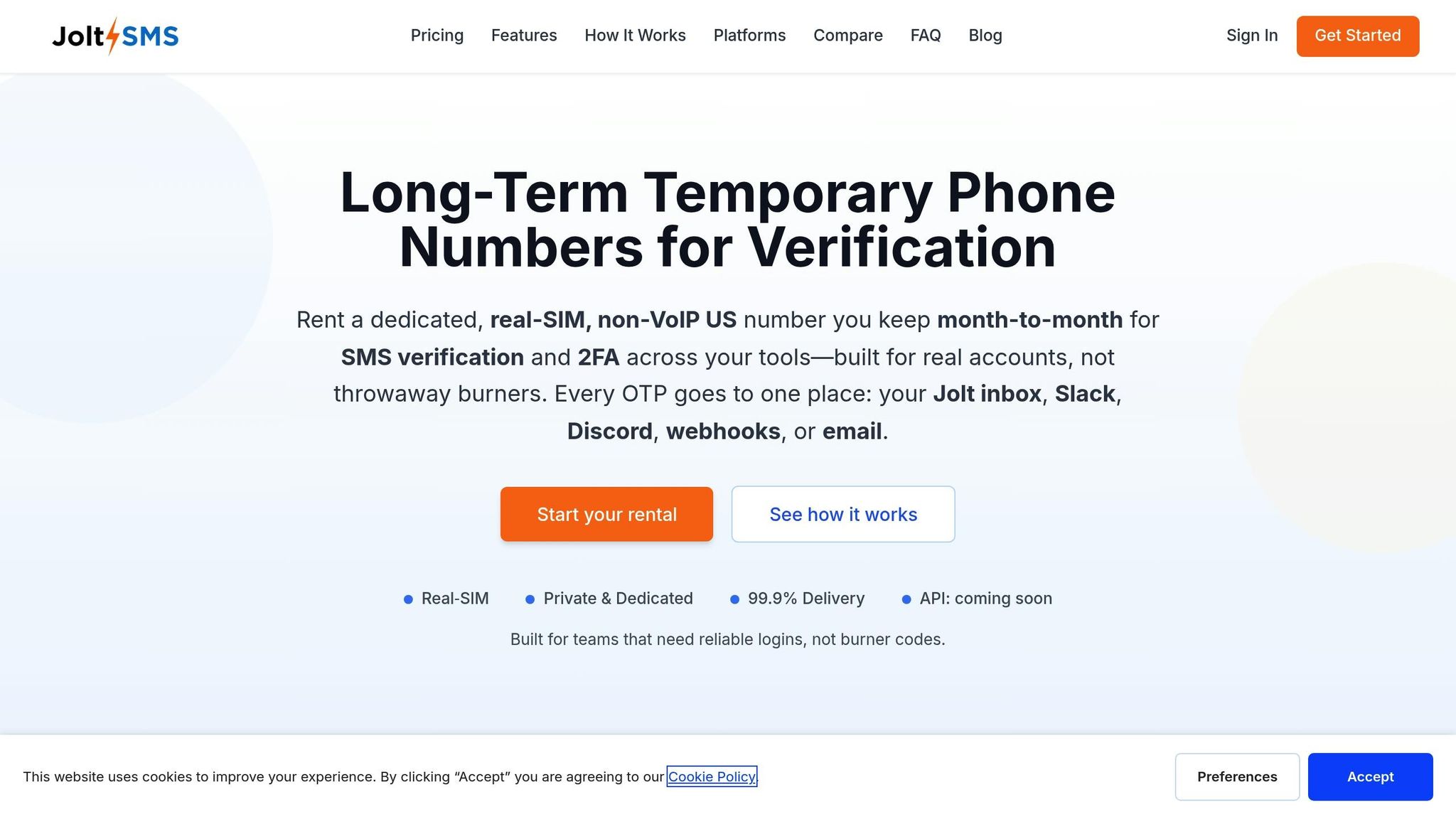
JoltSMS takes the benefits of real-SIM numbers a step further by offering a seamless and effective solution for businesses. Their service provides dedicated US real-SIM numbers for $50 per month, with optional $3.50 add-ons for specific area codes [1]. Each number is private, reducing the risk of blacklisting and ensuring consistent performance. With a 99.9% delivery rate for verification codes, JoltSMS even offers a money-back guarantee if SMS verification fails.
The service delivers verification codes straight to your team through Slack, Discord, email, or custom webhooks, all secured with HMAC-SHA256 encryption [1]. You’ll also receive instant dashboard notifications via Socket.IO, along with team access for up to 10 members, role-based permissions, and unlimited inbound SMS under fair-use policies [1]. Numbers renew automatically with a minimum 30-day commitment, ensuring uninterrupted service during critical re-verification periods. For agencies managing multiple clients, JoltSMS makes it easy to assign a dedicated number to each client, maintaining account isolation and long-term access [1].
sbb-itb-070b8f8
Building Fraud-Resistant Verification Workflows
To keep fraudsters out and ensure verification processes run smoothly, it's essential to integrate real-time validation, dedicated real-SIM numbers, and smart monitoring practices into your signup and authentication workflows. These steps build on earlier fraud detection strategies, creating a more secure and seamless verification experience.
Using Real-Time Number Validation
When users enter their phone numbers during signup, validate them immediately using a reliable API. This step helps identify issues before sending verification codes. Ensure the numbers follow the E.164 format (e.g., +14155552671) and use line type intelligence to differentiate between mobile, landline, VoIP, and disposable numbers [3].
Risk scoring can further enhance this process by evaluating historical abuse patterns and sudden activity spikes (like multiple accounts linked to a single number) on a 0-100 scale. For medium-risk numbers, consider step-up authentication instead of outright blocking. For instance, combine phone verification with email checks or voice call backups. Also, keep an eye out for behavioral inconsistencies, such as mismatches between a number's geographic origin and the user's IP address, or signs of recent SIM swaps or porting - both of which are major indicators of potential account takeovers.
Once numbers are validated in real time, protect high-value accounts by using dedicated real-SIM numbers.
Setting Up Dedicated Real-SIM Numbers
For accounts that are critical to your business - like managing client social media profiles, accessing payment processors, or running agency operations - opt for dedicated real-SIM numbers that you can control over the long term. Choose services offering multi-channel routing, so verification codes can be delivered via Slack, Discord, or webhooks. Additionally, ensure access is restricted through role-based permissions (e.g., Owner, Manager, Viewer) to enhance security [1].
For example, JoltSMS offers a solution at $50 per month per number, including unlimited inbound SMS and support for up to 10 team members. This makes it a practical choice for agencies juggling multiple client accounts [1].
Avoid relying on public free numbers for sensitive operations. While the $50 monthly cost might seem steep, it's a small price compared to the average $15,000 loss per incident caused by synthetic ID fraud [3].
How to Avoid Verification Failures
To minimize verification failures, stick to real-SIM numbers for SMS verification and reserve VoIP numbers for calls. Continuous monitoring is crucial, as a number considered safe today could become risky tomorrow due to porting or SIM swaps. Re-verify high-value accounts periodically to maintain their security [3]. Additionally, standardize all phone numbers in the E.164 format across your systems to avoid delivery issues caused by malformed numbers.
Conclusion
What Businesses Need to Remember
Fraud detection systems increasingly flag temporary and VoIP numbers due to their association with high levels of fraudulent activity [3][2]. With 74% of fintech fraud tied to mobile numbers and synthetic identity fraud averaging losses of $15,000 per incident [3], relying on carrier-issued numbers has become more important than ever.
Platforms like WhatsApp, PayPal, and many banking apps reject VoIP numbers because they can be created in bulk and lack the traceability of carrier-issued lines [2]. This is why businesses are pivoting toward real-SIM numbers. These numbers, tied to physical SIM cards from carriers like AT&T or Verizon, are far harder to fake and consistently meet strict verification standards. Using real-SIM numbers not only ensures secure verification but also provides businesses with lasting control over their accounts. While VoIP services can still be useful for business calls, they fall short when it comes to verification needs.
Getting Started with JoltSMS
JoltSMS offers dedicated US real-SIM numbers at $50 per month, including unlimited inbound SMS and integration options with Slack, Discord, or webhooks [1]. Their service boasts a 99.9% delivery success rate across over 1,000 platforms and includes a money-back guarantee if verification fails. For agencies managing multiple accounts, JoltSMS supports teams of up to 10 members with role-based permissions, ensuring secure and streamlined access.
FAQs
Why do platforms block temporary phone numbers?
Platforms block temporary phone numbers because they’re often linked to misuse and fraudulent behavior. These numbers, typically associated with disposable or VoIP services, are easy to obtain and are frequently used to create fake accounts or bypass security protocols. To combat this, platforms deploy fraud detection systems that identify patterns like mass account creation or suspicious activities connected to these short-lived numbers.
Services like banks, payment processors, and apps that rely on SMS verification also reject temporary or VoIP numbers to safeguard their systems and maintain security. For businesses, depending on these numbers can result in verification failures or account restrictions. Opting for real-SIM numbers instead helps ensure smooth verification and avoids unnecessary complications.
Why are Real-SIM numbers better for SMS verification?
Real-SIM numbers are an excellent choice for SMS verification because they are genuine mobile numbers connected to actual cellular networks. Unlike VoIP or disposable numbers, which are often flagged or blocked due to their frequent misuse in fraudulent activities, Real-SIM numbers are widely trusted by more than 1,000 platforms, including banks and payment systems. This trust translates to a much higher success rate for verification processes, minimizing errors and disruptions.
Platforms tend to reject VoIP and temporary numbers because they’re easy to obtain and commonly exploited. In contrast, Real-SIM numbers adhere to strict security and compliance standards, making them a dependable and secure option for businesses that need consistent verification success. By relying on Real-SIM technology, companies can reduce verification failures and foster greater trust with their users.
Why shouldn't I use VoIP numbers for business verification?
VoIP numbers often face rejection from platforms like banks, Stripe, and WhatsApp when used for SMS verification. Why? They're viewed as less secure and legitimate compared to actual mobile numbers. This perception stems from how easily VoIP numbers can be obtained, often without rigorous identity checks, making them a target for misuse by fraudsters.
These numbers are also linked to fraudulent practices like SIM farms or number recycling, which undermine the reliability of verification processes. For businesses, depending on VoIP numbers can result in higher rejection rates and disrupt essential operations that depend on secure authentication.