Twilio Alternatives for Cloud SMS Verification

If Twilio's high costs, VoIP restrictions, and lengthy setup times are holding you back, you're not alone. Businesses are turning to alternatives that offer more affordable pricing, faster implementation, and solutions for receiving SMS verification codes from platforms like Google, AWS, and Stripe. Here’s a quick look at the top options:
- JoltSMS: Dedicated real-SIM US numbers for $50/month with unlimited inbound SMS. Works with over 1,000 platforms rejecting VoIP.
- Plivo: Low outbound SMS rates ($0.0055/message) and global coverage, ideal for high-volume messaging.
- Prelude: Smart routing across providers for reliable SMS delivery.
- Telnyx: Developer-focused API for outbound SMS, though less suited for receiving verification codes.
- Vonage: Enterprise-grade outbound verification API with advanced routing.
- MessageBird: Marketing-focused platform with CRM tools, less practical for verification needs.
Quick Comparison:
| Provider | Best For | Pricing | Key Feature | Limitation |
|---|---|---|---|---|
| JoltSMS | Receiving verification codes | $50/month (flat rate) | Real-SIM numbers for 99.9% delivery | Limited to US numbers |
| Plivo | Global outbound SMS | $0.0055/message | Affordable and flexible API | Manual setup; higher support fees |
| Prelude | Reliable routing | Varies by provider | Smart traffic orchestration | Relies on third-party platforms |
| Telnyx | Developer outbound SMS | Pay-per-use | Developer-friendly API | Not optimized for inbound codes |
| Vonage | Enterprise-scale verification | Tiered pricing | Adaptive Routing technology | Complex pricing |
| MessageBird | CRM and campaign integration | $0.0105/message + CRM fees | Built-in CRM tools | High costs for verification-only use |
If you need to receive verification codes, JoltSMS is a standout with its real-SIM numbers and flat-rate pricing. For outbound messaging, Plivo and Vonage offer strong APIs, while Prelude excels in routing reliability.
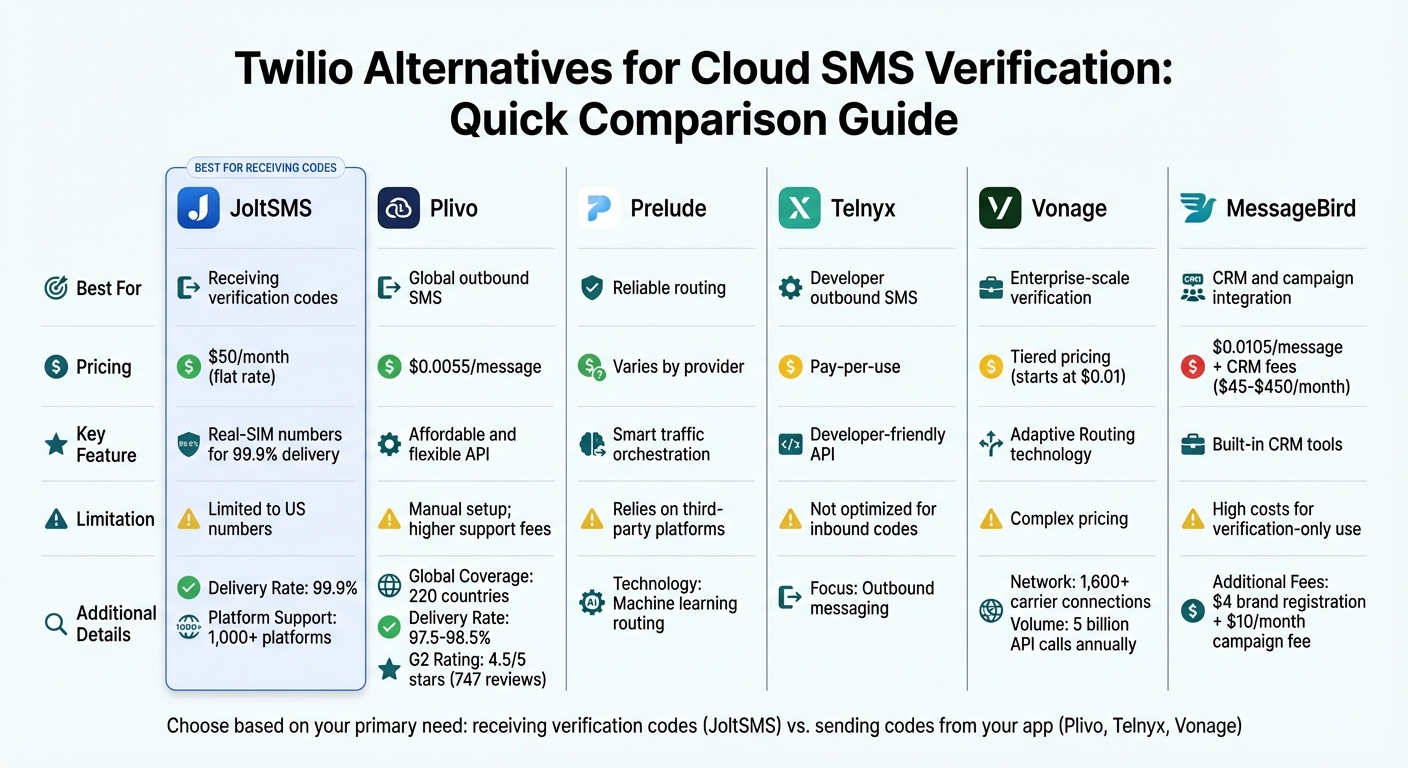
Twilio Alternatives Comparison: Features, Pricing, and Best Use Cases
1. JoltSMS - Dedicated Real-SIM US Phone Numbers for Business SMS Verification
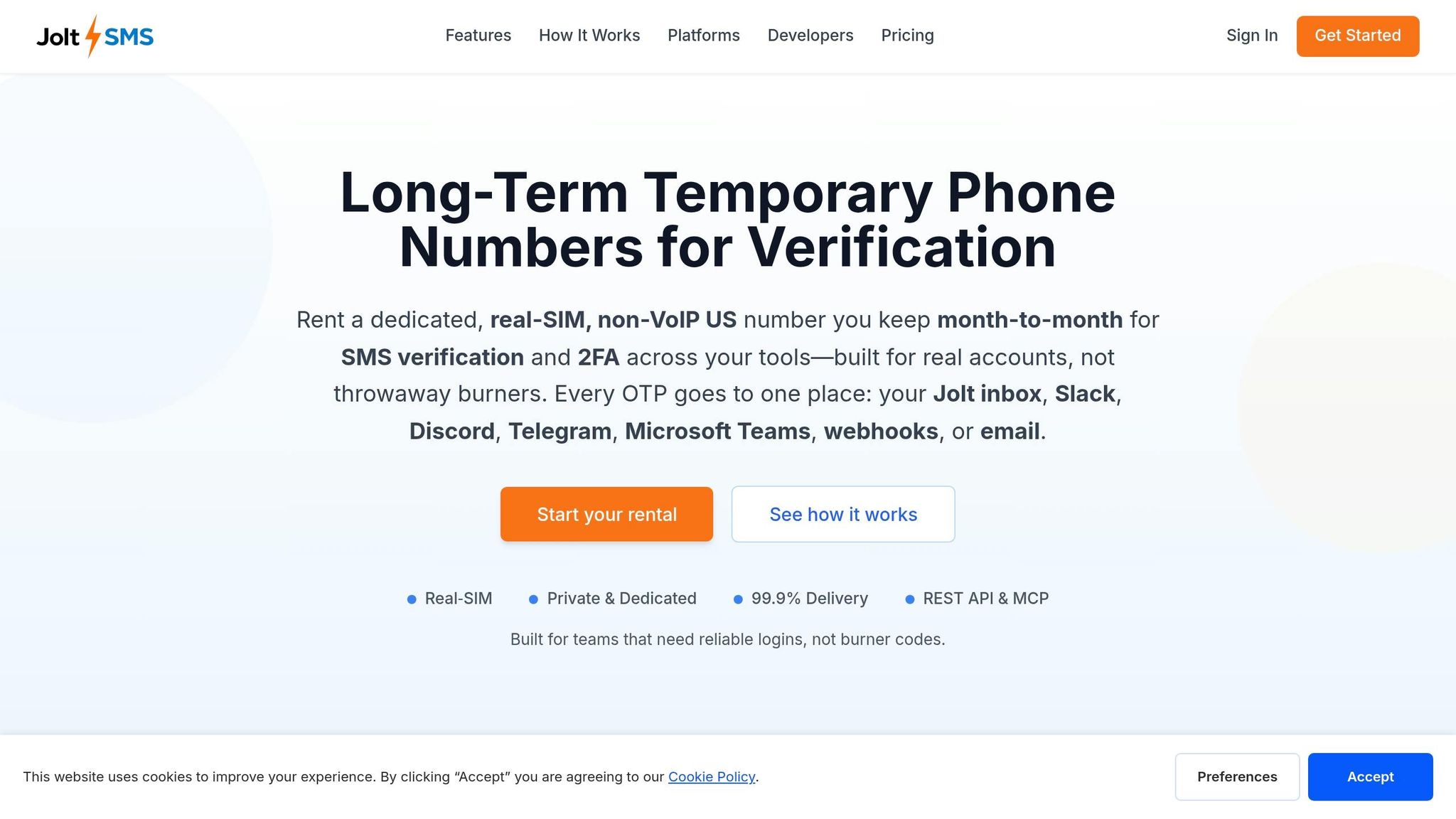
JoltSMS stands out by using dedicated, carrier-backed US SIM numbers instead of virtual lines. This approach bypasses verification blocks from platforms like AWS, Stripe, major banks, and Google, offering a dependable solution for businesses.
Pricing
For $50/month, JoltSMS provides dedicated numbers with unlimited inbound SMS under a fair-use policy [2]. Want a specific area code, like NYC or San Francisco? That’s just an extra $3.50/month [2]. The plan also includes features like role-based access for up to 10 team members, REST API, and webhook integration - all included in the base price.
Reliability
JoltSMS addresses common issues like delays and compliance challenges seen with other platforms, such as Twilio. Their carrier-backed real-SIM numbers deliver a 99.9% delivery rate across more than 1,000 platforms [3]. Unlike temporary or shared solutions, JoltSMS keeps your number private for the entire rental period, making it ideal for handling re-verification cycles on critical accounts.
Cloud Integration Features
JoltSMS integrates effortlessly through REST API, webhooks secured with HMAC-SHA256, and a real-time Socket.IO dashboard. This dashboard delivers instant code updates to workflows like Slack, Discord, Telegram, Microsoft Teams, or Email [2]. Developers can also use the REST API and Model Context Protocol (MCP) server to automate OTP extraction in CI/CD pipelines and AI-driven workflows [3]. This setup eliminates the hassle of sharing physical devices or login credentials within your team.
sbb-itb-070b8f8
2. Plivo
Plivo stands out for its simpler setup process and more affordable pricing compared to Twilio. It supports business texting in over 220 countries [6], using intelligent routing with carrier failover to maintain SMS delivery rates between 97.5% and 98.5% in areas with strong infrastructure [7]. Here's a closer look at its pricing, reliability, and integration options.
Pricing
Plivo offers outbound SMS rates as low as $0.0055 per message, which is significantly less expensive than Twilio's $0.0725. For businesses handling high volumes of messages, this can lead to considerable savings [7]. Local phone numbers are available for $0.50 per month, while toll-free numbers cost $1.00 per month. Businesses sending more than 200,000 messages monthly can also access volume discounts, making Plivo a great choice for those sending over 50,000 messages each month [7].
Reliability
With a global network spanning 190 countries, Plivo ensures reliable service through features like redundant routing and a dedicated Verify API for MFA and OTP. It holds SOC 2 and ISO/IEC 27001:2022 certifications, reinforcing its commitment to security. Plivo also provides 24/7 technical support via email, chat, and phone, with a guaranteed 4-hour response time for critical issues [5][8].
Cloud Integration Features
Plivo supports RESTful APIs and the SMPP protocol, along with SDKs for a variety of programming languages, including Python, Node.js, PHP, Java, C#, Ruby, and Go [6]. Its PHLO (Plivo High-Level Objects) drag-and-drop workflow builder simplifies the integration process compared to Twilio Studio [6]. Basic integration can be completed in 1–3 hours, while a full regional setup may take 1–2 weeks [7][8]. Additional tools include customizable webhooks for delivery callbacks, message segmentation control, and scheduling options [8].
"Plivo is a better match for smaller global teams looking for an affordable and developer-friendly CPaaS solution–especially businesses with high daily contact volumes."
– Eljohn Macaranas, Staff Writer, GetVoIP [6]
Plivo also receives high marks on G2, where it scores 4.5/5 stars from 747 reviews, outperforming Twilio's 4.1/5 from 504 reviews. Users specifically praise its ease of use (9.0 vs. Twilio's 8.2), ease of setup (8.8 vs. 7.7), and quality of support (8.5 vs. 7.8) [4]. These ratings underscore Plivo's appeal for developers and businesses looking for a cost-effective global messaging solution.
3. Prelude
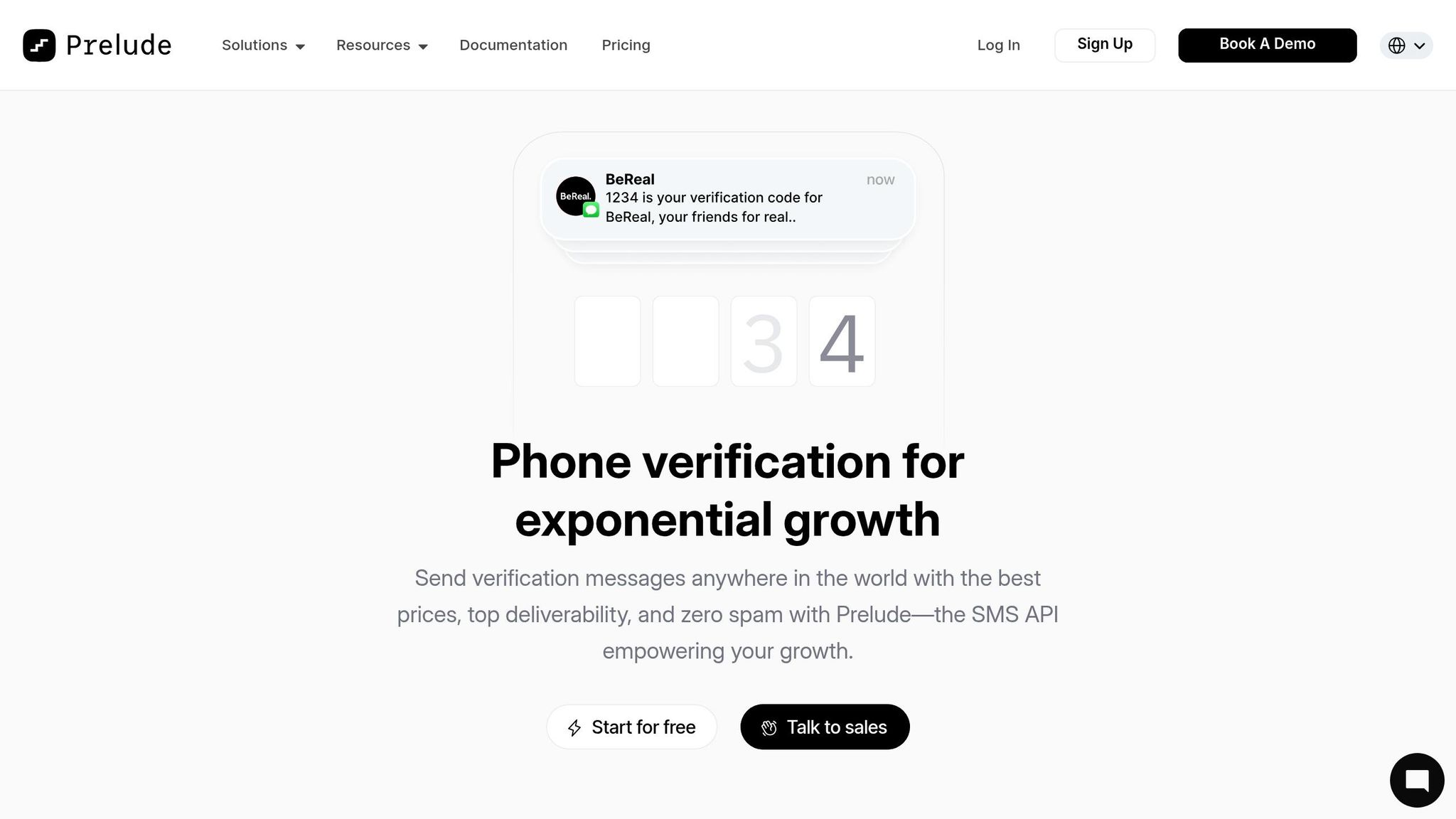
Prelude acts as a smart orchestration layer, directing SMS traffic through various providers like Twilio, Vonage, and Infobip. Its goal? To identify the most dependable route based on the region or carrier.
Reliability
By leveraging real-time data and machine learning, Prelude chooses the route most likely to succeed while avoiding providers experiencing downtime or delays. This ensures smoother SMS verification and higher success rates, making it a reliable solution for managing verification processes across different providers.
4. Telnyx Verify API
Telnyx stands out as an enterprise messaging platform focused on outbound SMS, which sets it apart from tools specifically designed for inbound SMS verification. This distinction plays a key role in how Telnyx compares to other verification solutions.
Pricing
Telnyx uses a pricing model that combines monthly fees with usage-based charges. While this approach might work for some, it can lead to unpredictable costs - especially for businesses that only need to receive verification codes. For those looking for simpler, more consistent pricing, other providers might be a better fit.
Reliability
When it comes to outbound messaging, Telnyx performs well. However, its lack of optimization for receiving verification codes can lead to inconsistent delivery rates. This means businesses may need to invest extra effort in monitoring and troubleshooting.
Cloud Integration Features
Telnyx provides REST APIs for SMS and voice, but integrating these requires advanced developer expertise and a significant time investment. Additionally, users must build custom monitoring systems and handle compliance requirements on their own. This can be a challenge for teams looking for a more straightforward, plug-and-play verification solution.
5. Vonage Verify API
The Vonage Verify API is specifically designed for sending SMS verification codes, not for receiving them. Like Telnyx, it caters to developers who want to integrate verification capabilities into their applications. However, it’s not intended for receiving codes from services such as Google, WhatsApp, or banking apps.
Pricing
Vonage employs a tiered pricing model with volume discounts. According to its AWS Marketplace listing, the base usage starts at $0.01 [11]. One key advantage over Twilio is that Vonage offers free inbound messages in many regions [10], unlike Twilio, which charges about $0.0075–$0.0083 per inbound message [9][10]. That said, for businesses focused solely on receiving verification codes rather than sending them, this pricing structure might not be the most practical fit.
Reliability
Vonage stands out for its strong focus on message deliverability. Its Adaptive Routing technology, a patented algorithm, dynamically re-routes messages through the most efficient carrier paths in real-time [9][10]. This reduces latency and enhances delivery success compared to standard routing methods. Globally, Vonage leverages over 1,600 direct-to-carrier and Tier 1 connections [9] and processes approximately 5 billion API calls annually [10].
A notable example of its reliability is BlaBlaCar, a carpooling platform with 70 million members. In October 2020, the company adopted Vonage's SMS API for two-factor authentication. By utilizing Vonage's direct carrier routes, BlaBlaCar improved its verification success rate while cutting SMS delivery costs by 15% [10].
Cloud Integration Features
Vonage also offers tools that simplify integration. One standout feature is "Vonage AI Studio," a drag-and-drop interface that lets businesses create verification workflows without requiring extensive programming knowledge [9]. This no-code approach makes it accessible to a broader range of users. Hardik Shah from Simform highlighted its user-friendly design:
"Vonage takes the UX to a new level with graphical representations, call insights, track of conversions, and many other aspects to support your campaigns" [10].
Note: Vonage is optimized for outbound SMS. If you need a reliable service for receiving verification codes, consider alternatives like JoltSMS, which offers real-SIM phone numbers for this purpose.
6. MessageBird Verify API
MessageBird takes a different angle compared to traditional verification services. Its focus is more on catering to marketing teams, offering tools like integrated CRM and campaign management, rather than being a straightforward verification solution. This makes it less ideal for businesses that require a dedicated verification setup.
Pricing
MessageBird's SMS cost is $0.0105 per message, which might seem appealing at first glance. However, there are additional costs to consider: CRM subscriptions range from $45 to $450 per month, a $4 brand registration fee, and a minimum $10 monthly campaign fee. For smaller businesses, these extra charges can quickly outweigh the savings on SMS costs, making it a more expensive option overall. [1] While this pricing structure aligns with MessageBird’s marketing capabilities, it’s not the most economical choice for verification needs.
Reliability
When it comes to outbound marketing campaigns, MessageBird performs well. However, it’s not tailored for receiving verification codes. For US-based users, the manual A2P 10DLC compliance registration process typically takes 1 to 2 weeks - quicker than Twilio’s 2 to 8-week timeline. [1] That said, its reliability for verification purposes is limited, as the platform is built with marketing, not verification, in mind.
Cloud Integration Features
Support is another area where MessageBird leans toward larger enterprises. Dedicated customer support is available only for enterprise-level contracts, leaving smaller businesses with fewer support options. [1] If your main focus is receiving SMS verification codes, MessageBird’s marketing-driven design may not meet your needs. In such cases, JoltSMS is a better alternative, offering real-SIM numbers specifically for receiving codes.
Note: MessageBird is primarily designed for sending verification codes from your application. If you need a service for receiving SMS verification codes from platforms like Google, WhatsApp, or banking apps, check out JoltSMS, which specializes in this functionality with dedicated real-SIM numbers.
Comparison: Pros and Cons
Here's a quick breakdown of how different providers stack up, making it easier to decide which one suits your needs best.
| Provider | Best For | Pricing Structure | Key Advantage | Main Limitation |
|---|---|---|---|---|
| JoltSMS | Receiving verification codes from platforms like banks, fintech, AWS, and Stripe | $50/month flat rate (unlimited inbound SMS) | Real-SIM technology accepted by over 1,000 platforms with a 99.9% delivery rate[3] | Limited to US numbers and can't send codes from your app |
| Plivo | General-purpose SMS with global reach | Around $0.010 per SMS, plus $10+/month campaign fees and $4 for brand registration[1] | Extensive global coverage and flexible API | Manual A2P 10DLC setup takes 1–2 weeks; support starts at $250/month[1] |
| Telnyx Verify API | Developers integrating verification into apps | Pay-per-message (varies by region) | Developer-friendly API with competitive rates | Requires technical skills and isn't designed for receiving codes |
| Vonage Verify API | Large-scale enterprise verification workflows | Pay-per-verification attempt | Multi-channel verification (SMS, voice, email) | Complicated pricing and primarily enterprise-focused |
| MessageBird Verify API | Marketing teams needing CRM integration | About $0.0105 per SMS, plus $45–$450/month CRM fees and $10+/month campaign fees[1] | Built-in CRM and campaign tools | High monthly costs for verification-only needs |
JoltSMS stands out with its straightforward $50/month plan, which includes unlimited inbound SMS and team integration via Slack, Discord, or Microsoft Teams[2]. This makes it a solid option for predictable costs and smooth collaboration.
For developers who need to add SMS verification to their apps, Plivo and Telnyx Verify API offer flexible APIs, though they demand some technical expertise to set up. On the other hand, MessageBird caters more to marketing teams, but its higher fees reflect its focus on CRM tools rather than simple verification workflows.
The bottom line? If your priority is receiving verification codes from platforms like Google, WhatsApp, or banking apps, JoltSMS is your go-to solution. While many providers excel at sending codes, JoltSMS is uniquely equipped to reliably receive them from third-party platforms.
Conclusion
Selecting the right SMS verification solution largely depends on your specific goals. For developers creating apps that send verification codes to users, enterprise APIs like Plivo, Telnyx, or Vonage can be a solid choice - though they come with added complexity and per-message costs. On the other hand, if your business needs to receive verification codes from platforms like AWS, Stripe, banking apps, or WhatsApp, your requirements are entirely different.
This is where tailored solutions come into play. JoltSMS offers a unique approach with real-SIM, non-VoIP US numbers that work seamlessly on over 1,000 platforms known to reject VoIP numbers[3]. At $50 per month with unlimited inbound SMS, it provides predictable pricing without the hidden fees often tied to enterprise APIs. What truly sets it apart is its ability to route one-time passwords (OTPs) instantly to collaboration tools like Slack, Discord, or Microsoft Teams. This feature enables up to 10 team members to securely access verification codes without needing a physical device.
This shared access becomes essential for teams where different departments - such as finance handling banking codes or developers managing AWS accounts - need real-time access to verification messages. While low-cost options might suffice for verifying less critical accounts, high-security platforms like banks, fintech apps, or cloud services demand a more robust solution. In these cases, the $50 monthly investment in a real-SIM number not only ensures successful verifications but also helps avoid account blocks and disruptions.
FAQs
Do I need a service that sends verification codes or one that receives them?
You need a service that provides a dedicated, real-SIM number capable of receiving verification codes. This ensures you can accept OTPs from platforms such as Google, WhatsApp, and banking apps. Many services block VoIP numbers for account verification and re-verification, making a real-SIM number a must-have for these purposes.
Why do SMS verification codes fail on VoIP numbers?
SMS verification codes often don’t work with VoIP numbers because these numbers operate over the internet rather than traditional phone networks. Without support from physical carriers, VoIP numbers are more prone to being flagged or rejected by platforms that prioritize carrier-verified numbers for added security and dependability.
What should I check before switching off Twilio for SMS verification?
Before moving away from Twilio, make sure the new service meets key requirements for reliability. It should be able to consistently receive verification codes from crucial platforms like Google or banking apps. Check that it uses real, carrier-backed US numbers instead of VoIP, offers dedicated, long-term numbers, and supports instant OTP delivery. Additionally, ensure it integrates smoothly with tools you rely on, like Slack or Discord.
Take time to evaluate factors like pricing, delivery success rates (aim for 99% or higher), and compatibility with your platforms. This preparation is essential to avoid disruptions during the transition.