Every Store and Brand Needs Its Own Verified Phone Number
When your Shopify 2FA lives on a team member's personal phone, their last day becomes your lockout. JoltSMS gives each store a dedicated, non-VoIP real-SIM number that belongs to the brand — not whoever set it up — so your whole team can act on verification codes without waiting for anyone's cell.
- Dedicated US number the brand owns — survives any team change without account recovery tickets
- Real-SIM, non-VoIP — accepted by Shopify, Stripe, PayPal, and every processor that rejects VoIP
- One number per store so multi-store operators keep each brand's verification cleanly separated
- Shared inbox with Team Access so your ops team, VA, or agency sees codes without using your personal phone
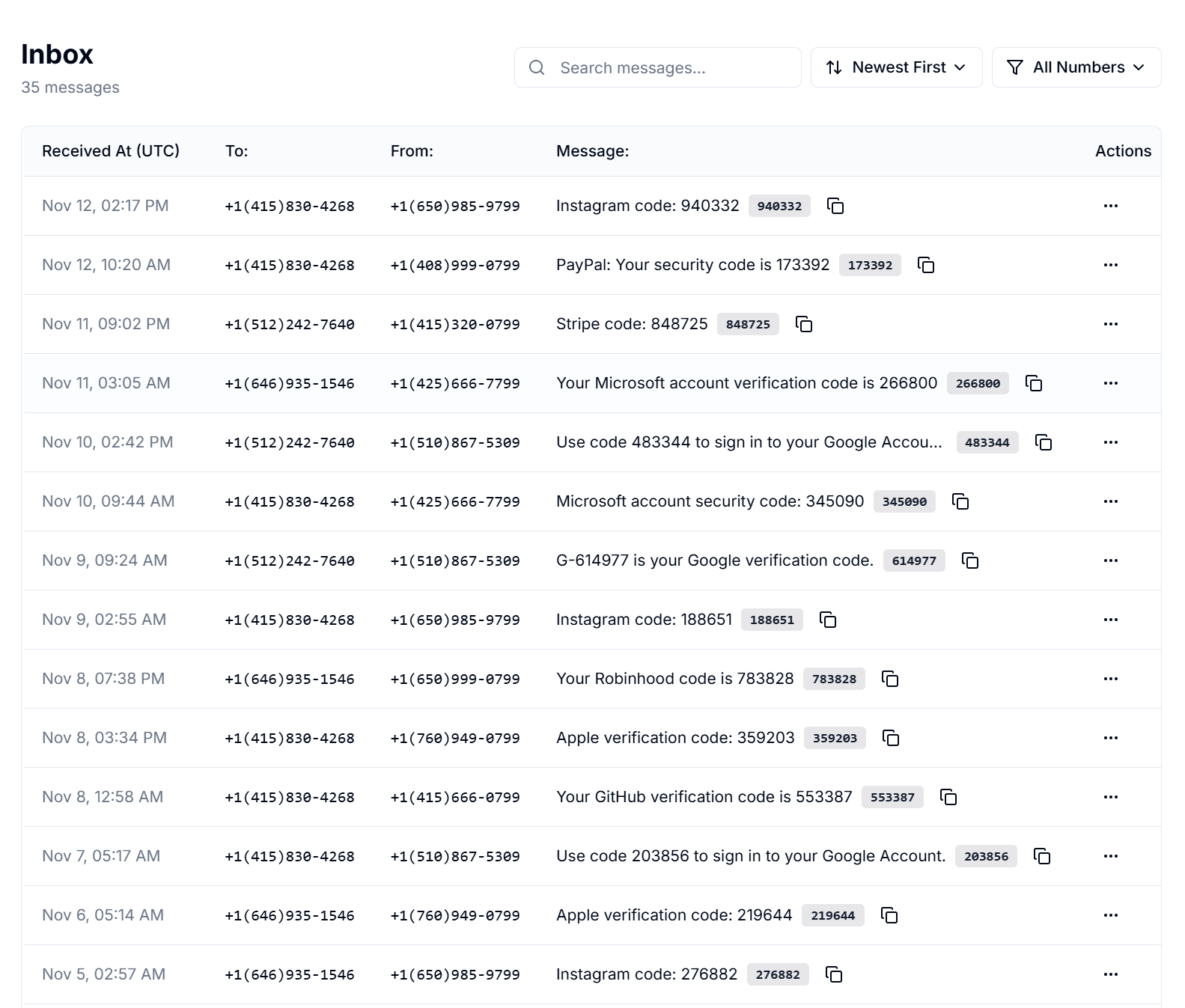
Verification codes land in a shared brand inbox — visible to your whole team the moment they arrive.
How ecommerce brands accidentally make phone verification a single point of failure
It starts on launch day. The founder registers the Shopify store using their personal cell as the 2FA number because it's the fastest option. Six months later a store manager is hired and given access — but the 2FA codes still go to the founder's phone. A year in, the brand launches a second Shopify store for a different product line, and the founder reuses the same number. Then comes the first real problem: the store manager leaves, and nobody changed any account settings. Or the founder tries to verify a Stripe merchant account for the new brand and gets rejected — VoIP flags. Or worse, both stores get hit simultaneously with a re-verification request from Shopify and the founder is traveling. What started as a convenient shortcut is now a per-store single point of failure that grows more dangerous with each person added to the team and each new brand launched.
| Problem | What it looks like for e-commerce brands |
|---|---|
| Shopify 2FA locked to a personal phone | A store manager or VA set up Shopify 2FA using their personal number. They leave the role. The account owner now has to go through Shopify's account recovery process — which can take 1-3 business days — while the store continues to run and time-sensitive actions (order holds, disputed charges, inventory updates) are blocked. |
| VoIP rejection at payment processors | Stripe, PayPal, and Shopify Payments each require a non-VoIP, real-SIM number for merchant account verification. Google Voice, TextNow, Twilio virtual numbers, and most VoIP services are rejected on submission. Founders using VoIP for convenience discover this only at the worst moment: during a payout hold or account verification triggered by a sales spike. |
| Same number across multiple stores | A dropshipper running four Shopify stores registers all of them with one personal number. Shopify's per-account 2FA policy means codes from all four stores go to one phone. When that phone is unavailable — or that person is no longer involved — all four stores are simultaneously at risk. |
| No team access to shared verification | The operations team and VAs working the store never have a legitimate way to receive Shopify 2FA codes on their own. They either share the owner's login (a security risk Shopify flags) or interrupt the owner every time a verification code is needed — which can be daily during ad account linking, payment method changes, or app integrations. |
| Agency can't act on client stores | An ecommerce agency managing client stores cannot action 2FA-gated tasks — publishing apps, linking ad accounts, updating payment info — without calling the client for a code from their personal phone. This introduces delays, frustrates clients, and creates an operational dependency that the agency cannot control. |
Turn verification from a personal phone problem into a brand-owned system
JoltSMS gives each of your stores a dedicated, non-VoIP real-SIM US number that belongs to the brand. Register it as the Shopify 2FA number, the Stripe merchant verification number, the PayPal business account number — and every code for that store goes to a shared inbox your whole team can access. When your ops team changes, the number stays. When you add a new VA, you give them team access. When you hand a client store back at end of engagement, the number transfers with the brand.
- Dedicated non-VoIP real-SIM number — passes Shopify, Stripe, PayPal, and Shopify Payments verification where VoIP numbers are rejected
- One number per store so each brand has a clean, separate verification identity — no shared-number conflicts across multiple stores
- Shared team inbox so your ops team, virtual assistants, and co-founders all see incoming codes in real time without sharing a personal phone
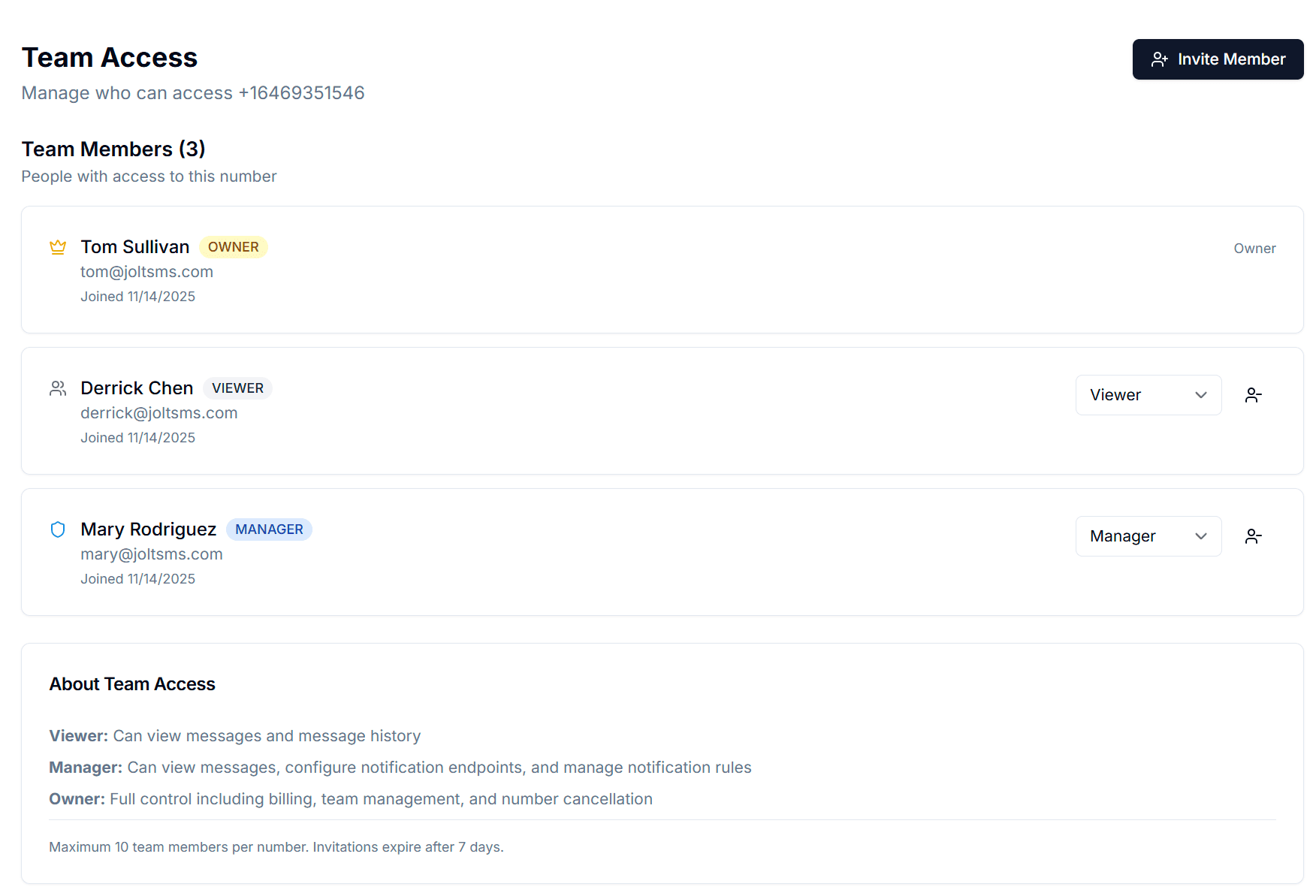
- Role-based Team Access — give your agency Manager access, your VA Viewer access, and keep Owner control yourself
- Instant notifications via Slack, email, or webhook so codes surface wherever your team already works, even during a store emergency at 2am
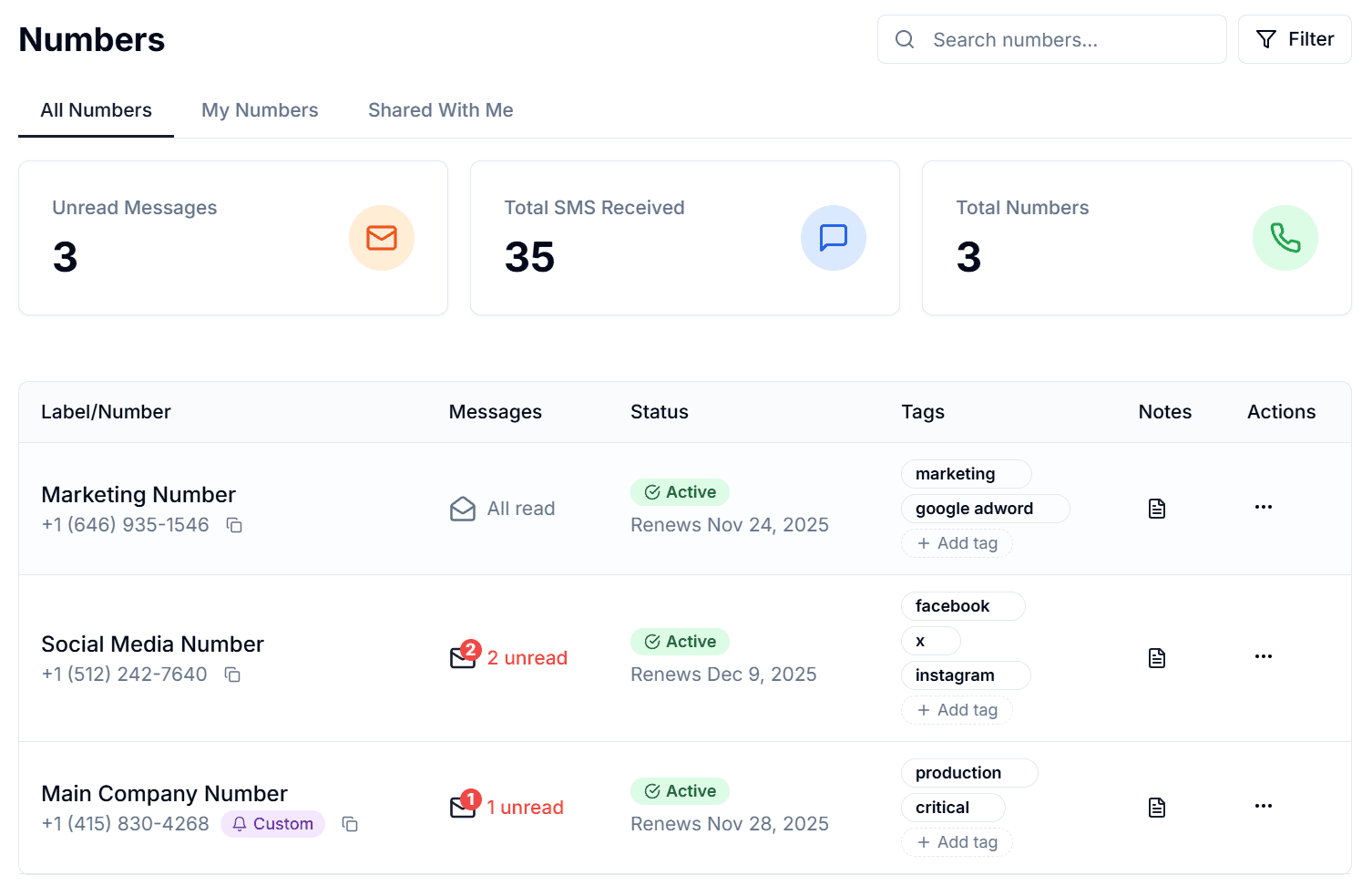
One number per brand. Each store keeps its own dedicated verification identity.
Common ways ecommerce brands use JoltSMS
Multi-Store Shopify Operator
A dropshipper running three Shopify stores under separate brand identities provisions one JoltSMS number per store. Each store's Shopify 2FA, Stripe merchant account, and PayPal business login is registered to its own dedicated number. When a VA handles one brand, they get team access on that number only — no cross-brand visibility, no shared personal phones, no lockout risk if the VA moves on.
DTC Brand Scaling a Team
A DTC brand grows from founder-only to a five-person ops team. Previously, the founder's personal phone was the 2FA number for Shopify, Klaviyo, and their Shopify Payments account. With JoltSMS, they provision one brand-owned number, replace all personal-phone registrations, and set up the ops team as Viewers in the shared inbox. New team members are onboarded without touching account settings. Departing members are offboarded with one role removal.
Ecommerce Agency Managing Client Stores
An ecommerce agency managing Shopify stores for five clients provisions a dedicated JoltSMS number for each client brand. The agency has Manager-level team access on each number during the engagement — so they can action 2FA-gated tasks without calling clients for codes. When the engagement ends, ownership transfers to the client. The number stays with the brand, not with the agency.
How an ecommerce brand typically rolls out a store-owned verification number
Provision one dedicated number per store
Sign up for JoltSMS and provision a US real-SIM number for each Shopify store or brand you operate. At $50/month per number, multi-store operators typically run 2-5 numbers for total stack coverage.
Replace personal numbers on every platform account
Update the 2FA phone number on Shopify, Stripe, PayPal, Shopify Payments, and any other platform the store uses — from personal cell numbers to the JoltSMS brand number. This is a one-time migration per store. Shopify's 2FA settings are under Account > Security; Stripe is under Settings > Team > Phone.
Invite your ops team with appropriate roles
Add your store manager, VA, or agency as Manager or Viewer in JoltSMS Team Access. Managers can configure notification rules; Viewers see incoming codes in the shared inbox. No one needs access to the account owner's personal device.
Route codes to where your team works
Set up Slack notifications to your ops channel, email forwards to a brand operations address, or webhooks to your order management system. When Shopify sends a 2FA code during a store emergency, it surfaces in your team's existing workflow — not buried in someone's personal Messages app.
Handle team changes without touching platform accounts
When a VA leaves or an agency engagement ends, remove their JoltSMS team access. The brand's JoltSMS number — and all associated platform registrations — remain unchanged. The store never loses a single day of verified access.
Give your ops team real access without handing out your personal phone
Ecommerce stores run on teams — VAs, ops managers, agency partners, co-founders. JoltSMS Team Access lets every person who needs to act on a verification code get it in real time, without the store owner becoming the single authentication bottleneck. Roles map cleanly to how ecommerce teams actually work.
- Owner role — Assigned to the brand founder or account holder. Controls billing, number provisioning, and full team management. This is the person whose credit card is on file for the store, not whoever happens to be managing operations today.
- Manager role — Assigned to ops managers, senior VAs, or agency account managers. Can configure notification routing and team membership without touching billing or number settings. Ideal for agency partners during an active engagement.
- Viewer role — Assigned to VAs, customer service staff, or junior team members who need to receive verification codes but should not be able to change store settings. Read-only inbox access keeps platform credentials secure.
- Invite team members by email with a 7-day expiry link. When a VA's contract ends or an agency engagement closes, one click removes their access. The store's JoltSMS number and every associated platform registration stays untouched.
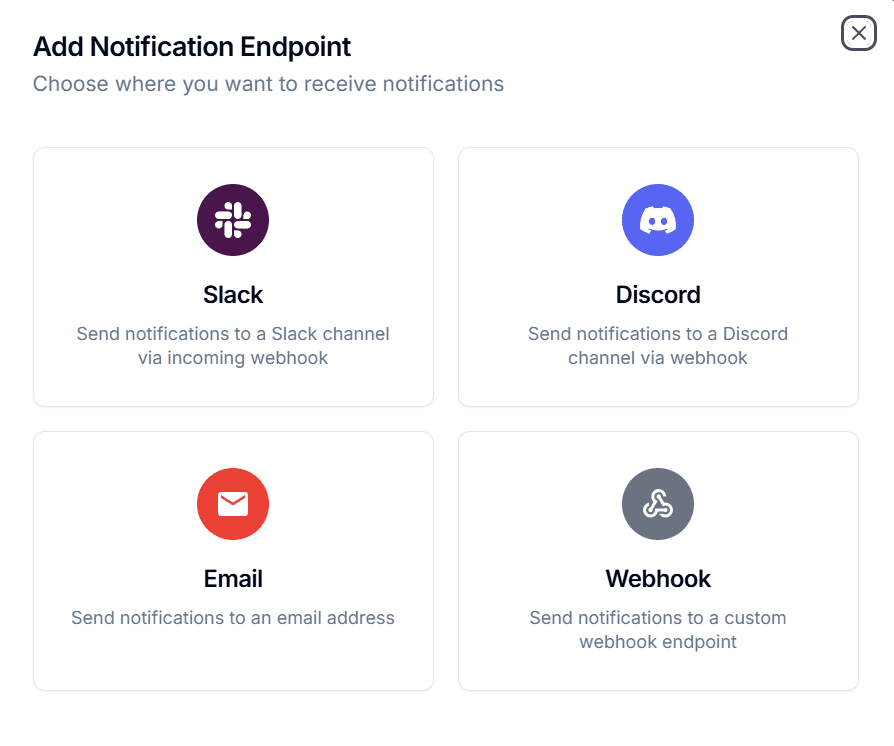
Get verification codes where your ecommerce team already works
Ecommerce ops teams run on Slack and email. JoltSMS delivers Shopify 2FA codes, Stripe verification codes, and PayPal confirmation messages to whatever channel your team monitors — so a time-sensitive code for an order dispute or payout hold never goes unseen because it landed on the owner's personal phone.
- Slack — Route Shopify and Stripe verification codes to your ops Slack channel. When a payout hold triggers a re-verification, the code surfaces in Slack before anyone has time to panic.
- Discord — Ecommerce teams running community-first DTC brands often coordinate in Discord. Route store verification codes directly to a private ops channel so the team sees codes without leaving their existing workflow.
- Email — Forward all incoming codes to a brand operations email address. Every code becomes a timestamped email record — useful for tracking verification activity across multiple stores.
- Webhooks — For stores with custom order management systems or automation workflows, codes can be HTTP-posted to any endpoint. Connect JoltSMS to Zapier, Make, or your own backend to trigger automated responses the moment a verification code arrives.
Ecommerce brand verification — common questions
No — and this is one of the most common pain points for ecommerce brands. Shopify's authentication system accepts VoIP numbers for account creation, but Stripe, PayPal, and Shopify Payments all verify that phone numbers are genuine mobile numbers (non-VoIP) before completing merchant account verification. Google Voice, Twilio, TextNow, and most app-based numbers are flagged and rejected. JoltSMS numbers are real-SIM US numbers — the same category of number as a physical carrier SIM — and pass every VoIP rejection check we have tested across Shopify, Stripe, PayPal, and Shopify Payments.
Give every store its own verified phone number
Stop routing Shopify 2FA through personal phones. One dedicated JoltSMS number per brand keeps your stores accessible through every team change — at $50/month, it costs less than one hour of Shopify support recovery time.