OTP Compliance 101: Building an Audit Trail for 2FA

Every 2FA login requires a secure audit trail to document who accessed what, when, and from where. This ensures compliance with frameworks like SOC 2, HIPAA, and GDPR while providing evidence during security audits or breaches. Here's what you need to know:
-
What is an OTP Audit Trail?
- A timestamped log of authentication events.
- Tracks user identity, IP addresses, device details, login outcomes, and timestamps.
- OTP codes are never stored in plaintext to protect sensitive data.
-
Why Does It Matter?
- Compliance frameworks demand proof of access logs.
- Helps detect security threats like brute-force attacks or expired code misuse.
- Ensures adherence to NIST SP 800-63 guidelines for OTP usage and rate-limiting failed attempts.
-
Key Components of a 2FA Audit Trail:
- Event Logging: Tracks requests, deliveries, validations, and expirations.
- Metadata Capture: Logs user ID, session ID, IP address, location, and device details.
- Tamper-Proof Storage: Uses append-only databases and hardware-secured environments for encryption keys.
-
Best Practices:
- Use centralized SMS providers with webhook integrations for real-time logging.
- Automate alerts for unusual patterns like high failure rates.
- Test and document systems to ensure compliance readiness.
Platforms like JoltSMS simplify OTP management with reliable delivery, detailed logs, and compliance tools, avoiding issues with VoIP-based systems. This approach ensures secure, traceable, and compliant 2FA processes.
What Goes Into a 2FA Audit Trail
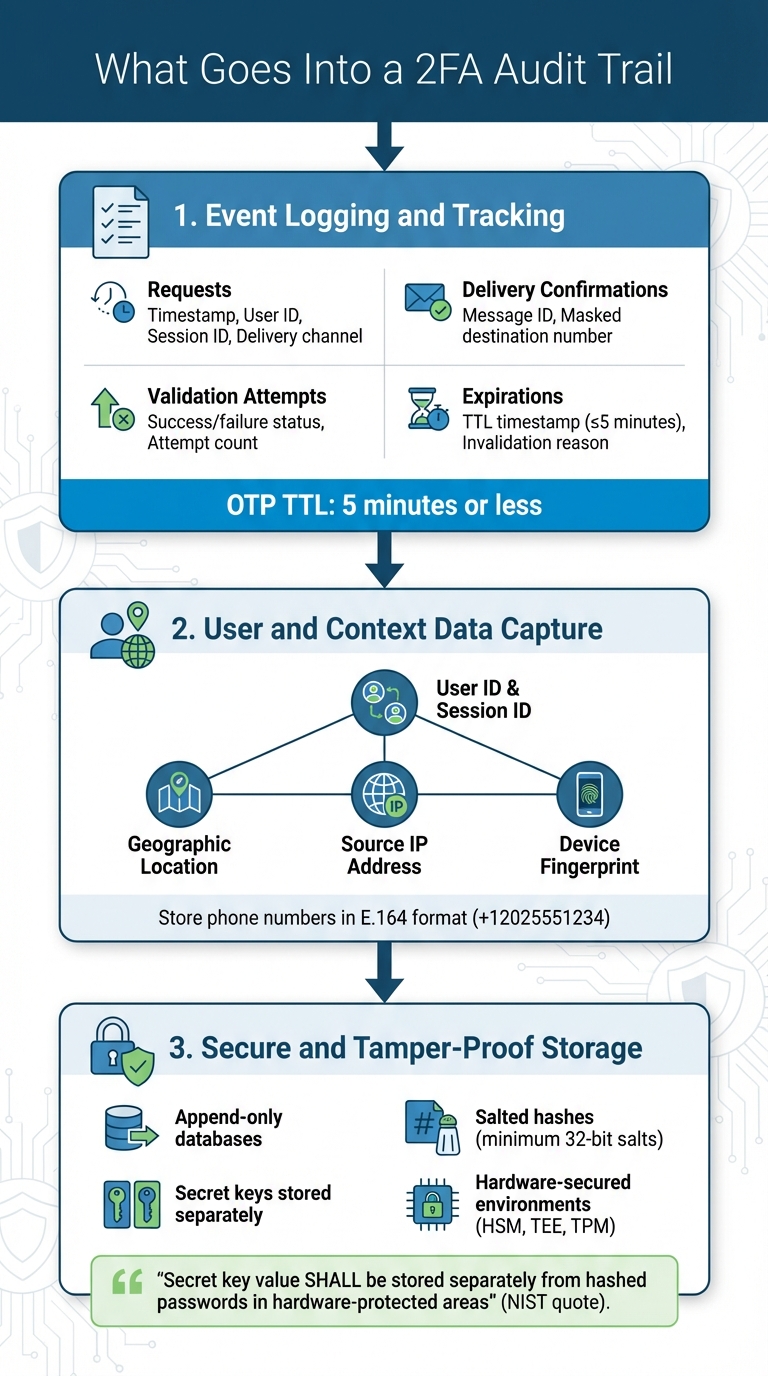
Key Components of a Compliant 2FA Audit Trail
A proper 2FA audit trail is built on three key elements: event logging, context capture, and tamper-proof storage. Together, these components create a reliable foundation for tracking and securing two-factor authentication processes.
Event Logging and Tracking
Accurate event logging is crucial for both compliance and security. A comprehensive audit trail should monitor four types of events:
- Requests: Record every request with details like timestamp, user ID, session ID, and delivery channel. This helps prevent flooding attacks.
- Delivery confirmations: Log the provider's message ID and the masked destination number to confirm that the code was successfully sent to the carrier.
- Validation attempts: Track whether each attempt was a success or failure, along with the number of attempts. This data can reveal patterns like brute-force attacks or issues with expired codes.
- Expirations: Document the time-to-live (TTL) timestamp and the reason for invalidation to ensure expired codes can't be reused.
To maintain security, set the OTP (one-time password) TTL to five minutes or less and invalidate codes after a single successful use [2][3].
User and Context Data Capture
An effective 2FA audit trail also includes detailed metadata for every event. This metadata should include:
- User ID and session ID
- Source IP address
- Geographic location
- Device fingerprint
These details offer the "Somewhere You Are" and "Something You Do" authentication factors that auditors often look for. Additionally, for consistent global tracking, store phone numbers in E.164 format (e.g., +12025551234). Using session IDs can also help tie together multiple authentication events within a single login session [2].
Secure and Tamper-Proof Storage
To prevent tampering, store audit logs in append-only databases or use salted hashes with a minimum of 32-bit salts. This approach minimizes the risk of accidental data exposure through debugging tools or metrics dashboards. Since 6-digit OTPs have a limited keyspace of about one million combinations, hashing them adds an extra layer of protection [1][2].
Keep secret keys used for hashing or encryption separate from the hashed data. Ideally, these keys should be stored in hardware-secured environments like Hardware Security Modules (HSM), Trusted Execution Environments (TEE), or Trusted Platform Modules (TPM) [1].
"The secret key value SHALL be stored separately from the hashed passwords. It SHOULD be stored and used within a hardware-protected area, such as a hardware security module or trusted execution environment (TEE)." - NIST [1]
This separation ensures that even if attackers gain access to your database, they won't be able to tamper with historical authentication records or cover up unauthorized access attempts [1][4].
How to Build an OTP Audit Trail
Creating a compliant OTP audit trail involves selecting a dependable SMS provider, setting up detailed logging, and rigorously testing your system to ensure it meets audit requirements.
Choosing a Centralized SMS Provider
The SMS provider you choose plays a crucial role in capturing the metadata necessary for compliance audits. Look for providers that use real-SIM technology rather than VoIP, as VoIP numbers are often blocked by major platforms.
An ideal provider should support webhook integrations, allowing OTP messages to flow directly into your logging system. This centralized setup ensures you can track every authentication attempt with key details like timestamps, delivery confirmations, and attempt counts. Providers offering REST API access are especially useful, as they enable you to programmatically retrieve message history and delivery statuses, which are essential for compliance reporting.
Setting Up Logging and Monitoring
To build a robust audit trail, log critical OTP event data, including:
- Identity metadata: Account IDs and masked phone numbers.
- Timestamps: When OTPs are created and when they expire.
- Attempt counts: Failed attempts and their originating IPs.
- Outcome status: Whether the attempt was successful or failed.
Implement automated alerts to flag abnormal failure rates, which could indicate issues like brute-force attacks or carrier delivery problems. To comply with NIST standards, set up rate-limiting to restrict the number of failed authentication attempts per account, especially for secrets under 64 bits in length [1].
Use TTL (time-to-live) mechanisms to automatically delete OTP records after 24 hours, minimizing data breach risks while adhering to retention policies. Ensure all OTP-related communications occur over encrypted and authenticated channels using approved encryption methods [1]. Additionally, store symmetric keys for OTP generation separately from hashed data, preferably in hardware-secured environments.
Testing and Documenting Your Audit Trail
Thorough testing is essential to verify your audit trail captures all necessary data. Simulate both successful and failed authentication scenarios, including expired codes, rate limits, and replay attempts. This ensures your system records every potential situation an auditor may review.
Document key details such as your OTP validity period, which should not exceed 10 minutes per NIST guidelines [5][1]. Outline written procedures that explain how your system prevents replay attacks by ensuring each OTP is accepted only once during its validity period [1]. Additionally, maintain records of your encryption methods, key storage practices, and access control policies. These documents demonstrate to auditors that your system follows industry standards and can trace any authentication event from start to finish.
"Verifiers SHALL ensure that alternative authenticator types are available to all subscribers and SHOULD remind subscribers of this limitation of PSTN out-of-band authenticators before binding one or more devices." - NIST [1]
Next, learn how JoltSMS can streamline the centralized management of your 2FA audit trail.
Using JoltSMS for Centralized 2FA Audit Trails
JoltSMS simplifies the management of OTP (One-Time Password) traffic by utilizing real-SIM technology instead of VoIP systems. Each dedicated U.S. number operates on carrier-grade SIM cards, ensuring authentication codes are delivered reliably to your team without the common blocks experienced by services like Google Voice or OpenPhone. This setup is designed to integrate seamlessly with advanced logging and compliance tools.
Key Features of JoltSMS
With webhook integrations, JoltSMS automatically sends OTP messages and metadata - such as MessageIDs, timestamps, and sender details - directly to your logging system. By handling this data server-side, it prevents users from tampering with audit records, ensuring that every authentication attempt is fully traceable. This functionality directly supports compliance logging requirements. Additionally, the real-time dashboard provides instant insights into SMS traffic, allowing compliance teams to monitor delivery statuses and flag unusual patterns without relying on manual checks.
The platform also enables routing of OTP codes to Slack or Discord channels, creating a centralized and efficient record-keeping system that meets audit standards. Unlike VoIP services, which often fail to provide consistent audit trails for number reassignments, JoltSMS ensures stability by maintaining dedicated numbers for at least 30 days with automatic renewals. This stability, combined with carrier-grade infrastructure, sets JoltSMS apart when compared side-by-side with traditional VoIP solutions.
JoltSMS vs. VoIP Services
JoltSMS offers a distinct advantage over VoIP services in maintaining compliant and reliable audit trails. While VoIP services are suitable for calls, they often struggle with SMS verification, particularly on high-security platforms like banking apps and cryptocurrency exchanges. Here's a comparison:
| Feature | JoltSMS (Real-SIM) | VoIP Services (Google Voice, OpenPhone) |
|---|---|---|
| Delivery Reliability | 99.9% acceptance on 1,000+ platforms, including banks, Stripe, and AWS | Frequently blocked by high-security platforms |
| Audit Logging | Automated webhooks capture MessageIDs, timestamps, and delivery status | Limited metadata; often requires manual export |
| Platform Compatibility | Recognized as legitimate mobile lines by verification systems | Flagged as VoIP; rejected by platforms like WhatsApp, Coinbase, and financial institutions |
| Number Stability | Dedicated numbers, never recycled during rental periods | Numbers may be reassigned, disrupting audit trails |
sbb-itb-070b8f8
Common Mistakes and How to Fix Them
Even with the best intentions, businesses often face challenges when implementing OTP audit trails. These mistakes can lead to compliance issues, security vulnerabilities, and difficulties in reconstructing complete records after an incident.
Incomplete or Inaccurate Logs
A vague log entry like "OTP sent" isn’t helpful during an audit if it doesn’t include critical details like when it was sent, who requested it, or whether it was successfully delivered. According to NIST, OTPs must be used only once and attempts should be strictly rate-limited, so it's essential to log every attempt accurately[1].
To ensure thorough records, your logs should capture all relevant data at the time of the transaction. This includes:
- Timestamps (both creation and update times)
- A unique identifier for each attempt
- The recipient's masked phone number (showing only 3–4 digits to protect privacy)
- Delivery status (e.g., pending, delivered, failed)
- Opt-in evidence that complies with CTIA messaging policies
Using webhook integrations to send this data server-side helps prevent tampering and ensures every authentication attempt is fully traceable. This level of precision lays the groundwork for consistent and centralized audit trails.
Keeping Data Too Long
Holding onto sensitive authentication data longer than necessary not only increases the risk of a data breach but can also violate SOC 2 standards. For instance, NIST guidelines require you to erase certain activation data immediately after the operation is complete[1]. However, many businesses mistakenly retain OTP logs indefinitely, turning them into liabilities instead of useful assets.
The solution? Set up automated purging policies that align with your compliance requirements. Clearly document your data retention schedule and configure your logging system to automatically delete records once their retention period expires. For more details on balancing compliance and data minimization, check out our article on data retention in SMS verification services.
VoIP-Based OTP Failures
"If a platform asks for a Non-VoIP number, a VoIP won't cut it. Non-VoIP proves authenticity; VoIP is treated like a disposable tool." [6]
VoIP numbers, like those from Google Voice or OpenPhone, are virtual and lack a physical SIM card, making them easy to generate in bulk. This is why platforms like banking apps, PayPal, and WhatsApp often block them - they don’t provide enough proof of a legitimate, traceable user. If you’re seeing repeated OTP failures, it may be due to untrusted infrastructure. The fix? Switch to real‑SIM services.
Real‑SIM services rely on numbers issued by major carriers like AT&T or T‑Mobile and are tied to physical hardware, offering better delivery rates and avoiding the "VoIP numbers not accepted" errors that can disrupt your audit trail. NIST SP 800-63B also advises logging risk indicators - like SIM changes or number porting - when using PSTN-based authentication[1]. Real‑SIM providers ensure stable, dedicated numbers, creating consistent and reliable audit trails, unlike VoIP services where frequent number reassignments can compromise compliance records.
Conclusion
Creating a compliant OTP audit trail doesn’t have to be complicated. The key lies in capturing the right data, storing it securely, and adhering to a scheduled purge to minimize risks and meet retention policies. As NIST aptly states: "The verifier SHALL comply with its respective records retention policies in accordance with applicable laws, regulations, and policies" [7].
Centralizing OTP delivery simplifies the process by consolidating authentication records, making compliance reviews more efficient. A unified log that automatically tracks details like creation timestamps, time-to-live (TTL), remaining attempts, and verification status provides exactly what auditors expect during SOC 2 reviews [5]. This centralized approach ensures a complete, chronological record that leaves no gaps.
The infrastructure you rely on plays a crucial role in ensuring compliance and audit readiness. Stable systems and controlled data retention are essential. Real-SIM services, for instance, offer dedicated numbers that platforms trust, reducing issues like VoIP number reassignments or delivery failures. Adding safeguards like rate-limiting for failed attempts, authenticated delivery channels, and monitoring for risks such as SIM changes further strengthens compliance efforts [1][7].
JoltSMS simplifies this process by providing webhook notifications, maintaining detailed logs, and ensuring 99.9% delivery reliability with real-SIM numbers accepted by over 1,000 platforms. With JoltSMS, you’ll have the audit trail, reliability, and documentation you need - without having to build everything from scratch.
FAQs
What is an OTP audit trail, and why is it important for compliance?
An OTP audit trail serves as a detailed log that records every instance of one-time password (OTP) generation and verification, including the user involved and the corresponding timestamp. This creates a transparent history, showing who accessed specific accounts and exactly when.
Keeping such records ensures accountability and supports compliance with standards like SOC 2, which emphasize thorough tracking and reporting of authentication activities. Centralizing these logs not only streamlines the audit process but also helps demonstrate that your security measures align with industry requirements.
Why shouldn’t I use VoIP numbers for two-factor authentication (2FA)?
VoIP numbers can be a shaky choice for two-factor authentication (2FA) because many platforms simply don’t support them. One big reason is that these numbers are often recycled or shared, which could put your account at risk. Plus, they’re more prone to SIM-swap attacks and other forwarding-related vulnerabilities, making them less secure compared to numbers tied to physical SIM cards.
If you want reliable and secure 2FA, sticking with a real-SIM number is the way to go. It offers better platform compatibility and helps minimize the chances of authentication issues or potential security breaches.
Why is it important to securely store OTP logs?
Keeping OTP logs secure and unchangeable ensures they remain tamper-proof, providing a reliable record of account access - who accessed what and when. This level of integrity is essential for adhering to compliance frameworks like SOC 2 and ISO 27001, as well as for performing accurate forensic investigations.
An unalterable audit trail not only strengthens security but also helps organizations prove accountability, meet regulatory requirements, and safeguard sensitive user information effectively.